1 Blockchain basics
This chapter covers
- What blockchain programming is
- Blockchain infrastructure in nodes, networks, and applications
- Blockchain distributed ledger technology
- The blockchain protocol at a high level
- Trust intermediation
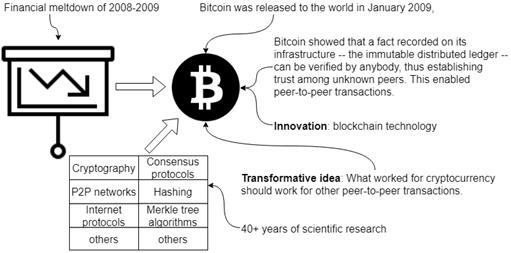
In the latter part of 2008 and early 2009, centralized systems of the world’s financial markets—enabled by large intermediaries such as banks and investment firms—failed and began to crumble. Trust in these systems eroded and panic set in all over the world with the collapse of the financial markets. It was at this juncture that a mysterious person or persons introduced to the world a working model of a peer-to-peer decentralized digital currency system (with no central authority or administration) called Bitcoin. All the intermediation in this system was realized via software that would later be named blockchain. It provided the software-based verification, validation, recording, and integrity essential for currency transfers. Even though Bitcoin appeared to have been launched suddenly in 2009, digital currency has been a quest since the dawn of computing. Blockchain technology stands on a strong foundation of more than 40 years of scientific research in cryptography, hashing, peer-to-peer networks, and consensus protocols. Its history is illustrated in figure 1.1.
Figure 1.1 The birth of blockchain technology