chapter eight
8 Distilling reasoning models for efficient reasoning
This chapter covers
- Hard and soft distillation for reasoning models
- Creating and preparing a teacher-generated reasoning dataset
- Training and evaluating a distilled student model using cross-entropy loss
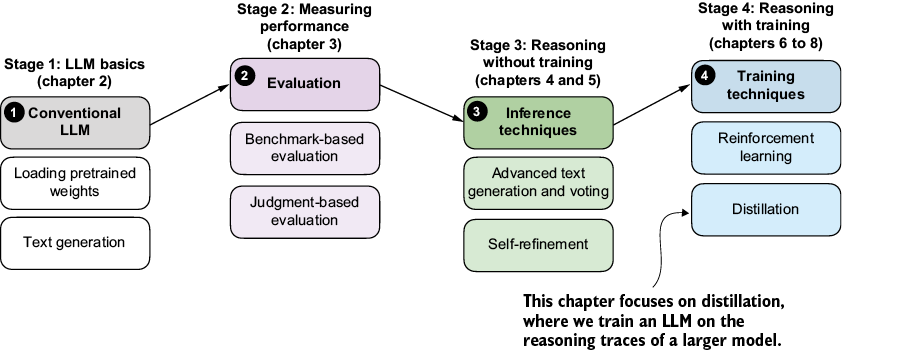
Reasoning performance can be improved not only through inference-time scaling and reinforcement learning, but also through distillation. In distillation, a smaller student model is trained on the reasoning traces and answers generated by a larger teacher model. As shown in the overview in figure 8.1, this chapter focuses on this training-time technique.
Figure 8.1 A model of the topics covered in this book. This chapter focuses on distillation, where a smaller student model is trained on reasoning traces generated by a larger teacher model.
We’ll look at model distillation in general before discussing the individual steps in the process.
8.1 Introducing model distillation for reasoning tasks
Model distillation involves training a smaller LLM, the student, on outputs produced by a larger LLM, the teacher. For reasoning models, these outputs usually include not only the final answer but also the intermediate reasoning trace that leads to it.