chapter four

4 How Machine Learning and Causal Inference can help each other


This chapter covers

  • What are we actually estimating when we use machine learning models?
  • When to use causal inference and when to use machine learning
  • How to use machine learning models in the adjustment formula
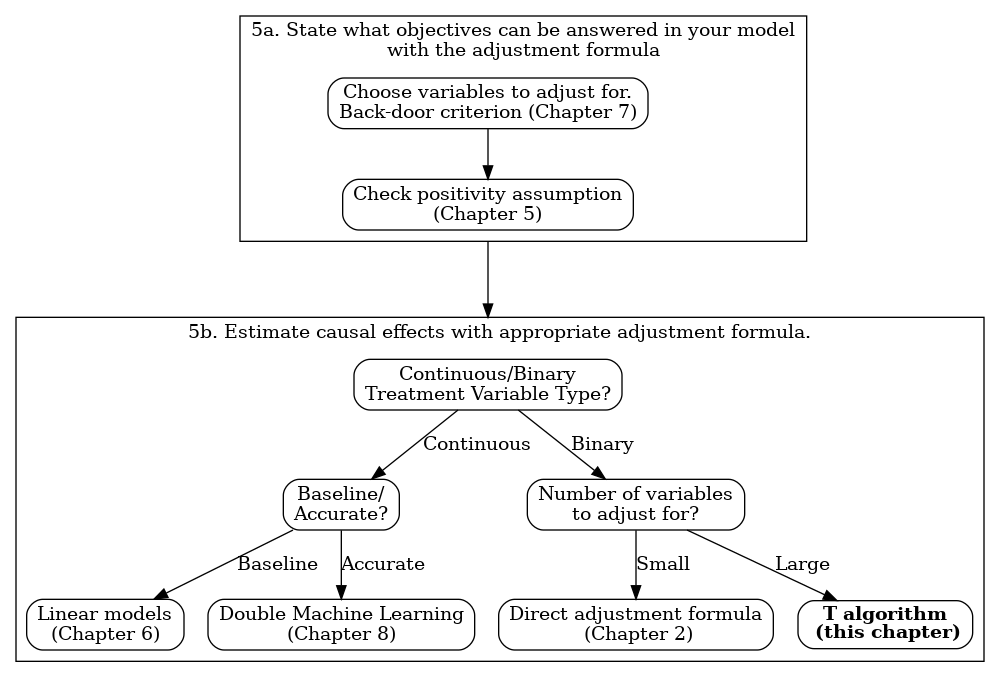
You are here
Figure 4.1 Applying the adjustment formula
RuizDeVilla Fig 2.11

In recent years, machine learning has experienced explosive growth across various domains, revolutionizing fields like image recognition, language translation, and autonomous vehicles. These advancements have been remarkable, often giving the impression that machine learning is the ultimate solution to replicate human intelligence. However, like any tool, machine learning has its limitations. One notable limitation, as we’ll explore in this chapter, is its struggle to effectively handle causality. To fully unlock its potential, AI will need to incorporate causal inference techniques alongside machine learning methods.

4.1 What does supervised learning actually do?

4.1.1 When to use causal inference vs supervised learning?

4.1.2 The goal of data fitting

4.1.3 When the future and the past behave in the same way

4.1.4 When do causal inference and supervised learning coincide?

4.1.5 Predictive error is a false friend

4.1.6 Validation of interventions

4.2 How does supervised learning participate in causal inference?

4.2.1 Empirical and generating distributions in the adjustment formula

4.2.2 The flexibility of the adjustment formula

4.2.3 The adjustment formula for continuous distributions

4.2.4 The S-Learner algorithm: a simple approach to evaluate the adjustment formula

4.2.5 The T-Learner algorithm: splitting data to improve

4.2.6 Cross – fitting: avoiding overfitting

4.3 Other applications of causal inference in machine learning

4.3.1 Reinforcement learning

4.3.2 Fairness

4.3.3 Spurious correlations

4.3.4 Natural Language Processing

4.3.5 Explainability

4.4 Further reading