1 Introduction to Triton
This chapter covers
- How GPUs accelerate modern workloads
- What Triton is and why it matters
- Why Triton bridges the gap between Python and CUDA
- Where Triton fits in the GPU ecosystem
- What you’ll learn next in this book
Over the past several years, GPUs have quietly become the engines driving modern computing. Whether it’s training massive language models, rendering photorealistic graphics, or crunching scientific simulations, chances are the real work is happening on a GPU. They’ve even been called the rare earth metals of artificial intelligence, according to NVIDIA, because they are foundational to today’s generative AI era.
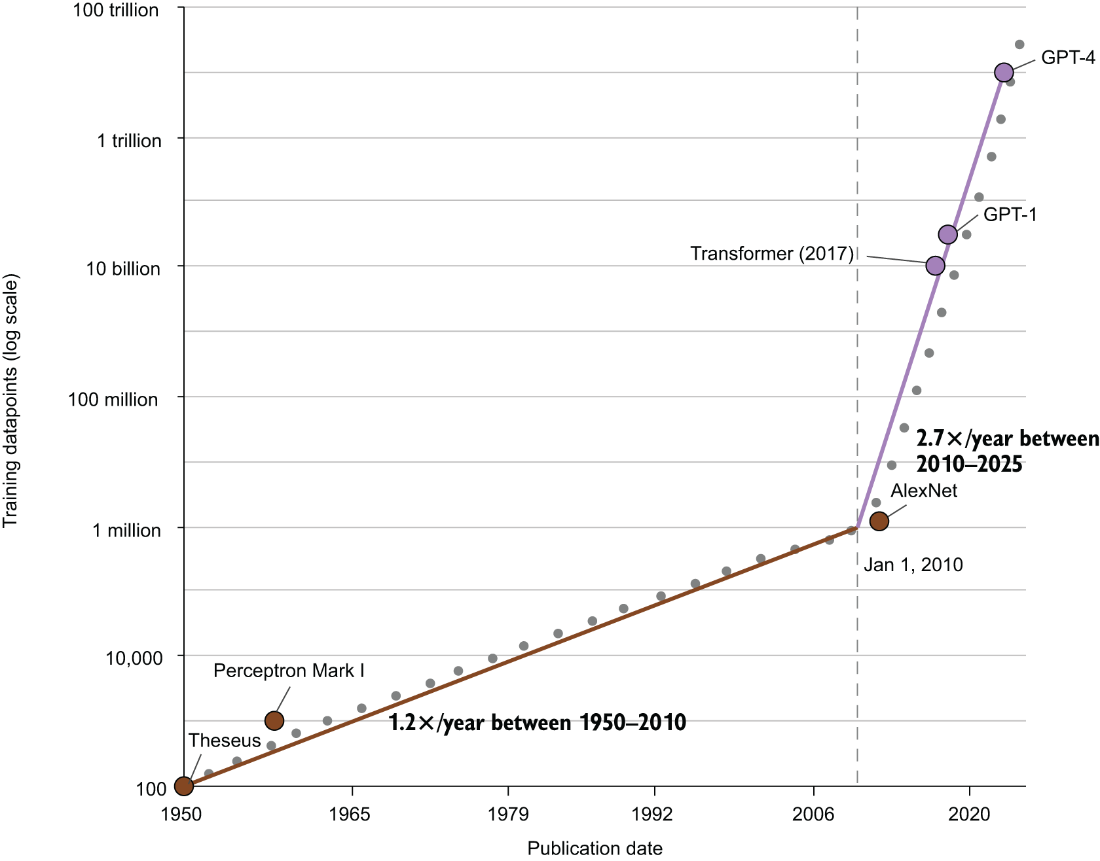
If you’ve trained a neural network recently, a GPU likely did most of the heavy lifting. In the last decade, model sizes and training datasets have surged, scaling from thousands of examples in early experiments to billions or even trillions of tokens today. Figure 1.1 shows how training data has grown exponentially over time (on a logarithmic scale).
Figure 1.1 Training data volume grew at a steady 1.2× annual rate between 1950 and 2010, then accelerated to 2.7× annual growth between 2010 and 2025. Source: Epoch AI.