5 Graph Attention Networks (GATs)
This chapter covers
- The notion of attention and how it is applied to GNNs
- The GAT and GATv2 layers in PyG and when to use either
- A brief look at mini-batching via the NeighborLoader class
- Implementing and applying GAT layers in a spam detection problem
In the last chapter, we examined convolutional GNNs, focusing on GCN and GraphSage. In this chapter, we extend our discussion of convolutional GNNs by looking at a special variant of such models, the Graph Attention Network.
Figure 5.1 Mental model of GNN training process, with the subject of GATs in context.
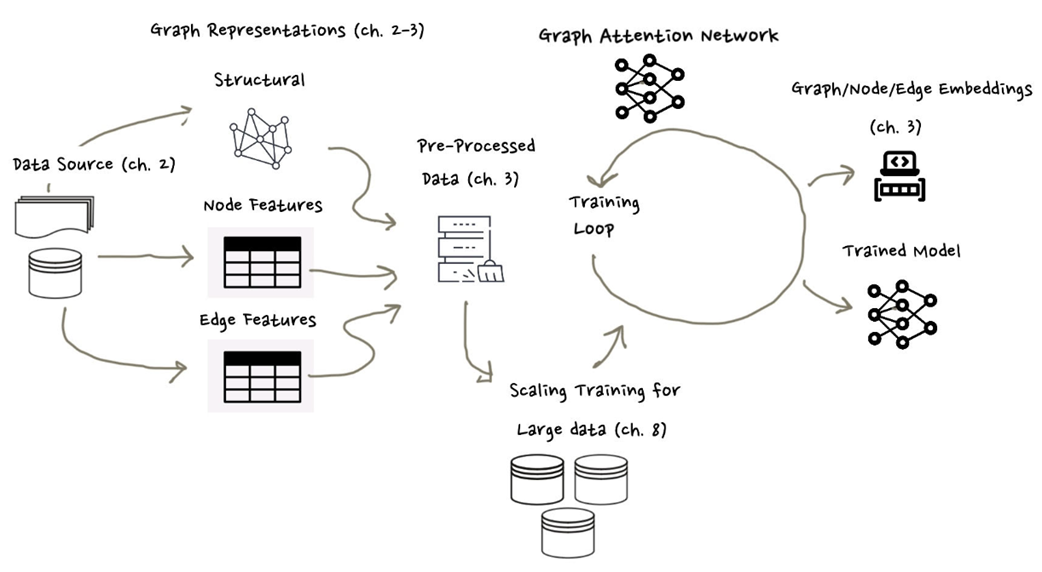
As with the previous chapter, our goal is to understand and apply Graph Attention Networks (GATs). While these GNNs use convolution as explained in chapter 4, they enhance this with an attention mechanism, which is a mechanism that highlights important nodes in the learning process. This is in contrast to conventional convolutional GNNs which treat all nodes equally.
As with convolution, attention is a widely used mechanism in deep learning outside of GNNs. Architectures that rely on attention (particularly transformers) have seen such success in addressing natural language problems that they now dominate the field. It remains to be seen if attention will have a similar impact in the graph world.