12 Bayesian decision theory: Making choices under uncertainty and risks
This chapter covers
- Maximizing expected utility under uncertainty
- Making sequential decisions in the optimal way
- Balancing between exploration and exploitation
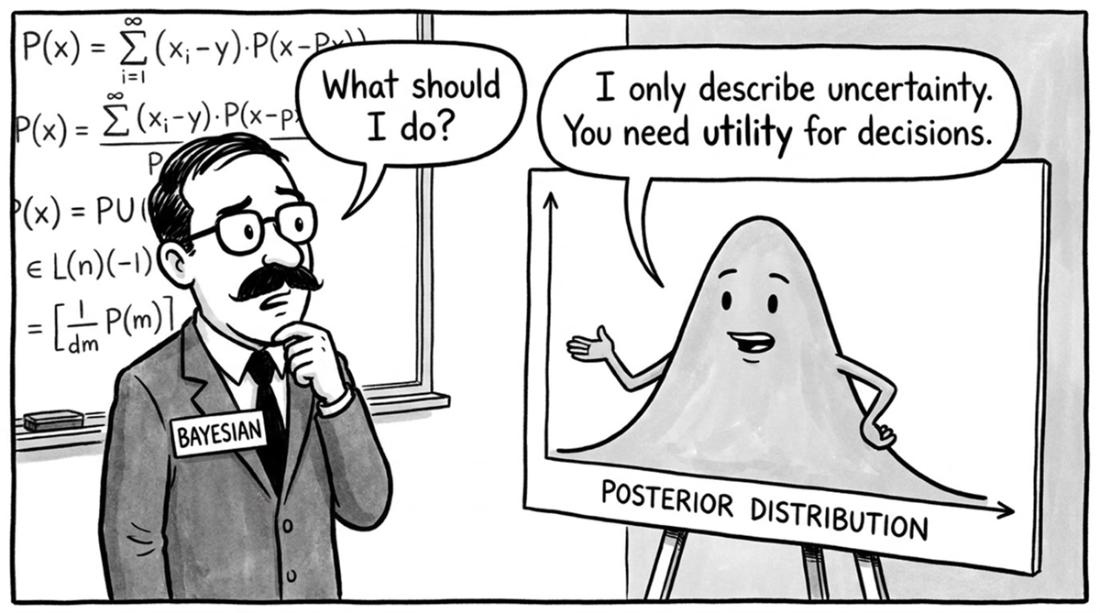
So far, we have focused on what to believe. We built priors, updated them with data, and used the posterior to make predictions and quantify uncertainty. But in practice, we rarely just care about beliefs—we care about what to do: whether we should launch the new website design, which policy to implement to maximize social welfare, or which molecules we should experiment on to find drugs to fight against a target disease.
In chapter 11, we saw a brief example of decision-making using Bayesian models. Here, a good decision depends on more than what the scenario most likely to take place is—it also depends on what the consequences under each scenario are. To make decisions under uncertainty, we need to combine: (1) our beliefs about the state of the world and (2) our preferences over outcomes. Bayesian decision theory formalizes this process and gives us a way to make principled decisions under uncertainty.