chapter ten

10 Combining building blocks to gain more power: Neural networks


In this chapter

  • what is a neural network?
  • the architecture of a neural network: nodes, layers, depth, and activation functions
  • training neural networks using backpropagation
  • potential problems in training neural networks, such as the vanishing gradient problem and overfitting
  • techniques to improve neural network training, such as regularization and dropout
  • using Keras to train neural networks for sentiment analysis and image classification
  • using neural networks as regression models
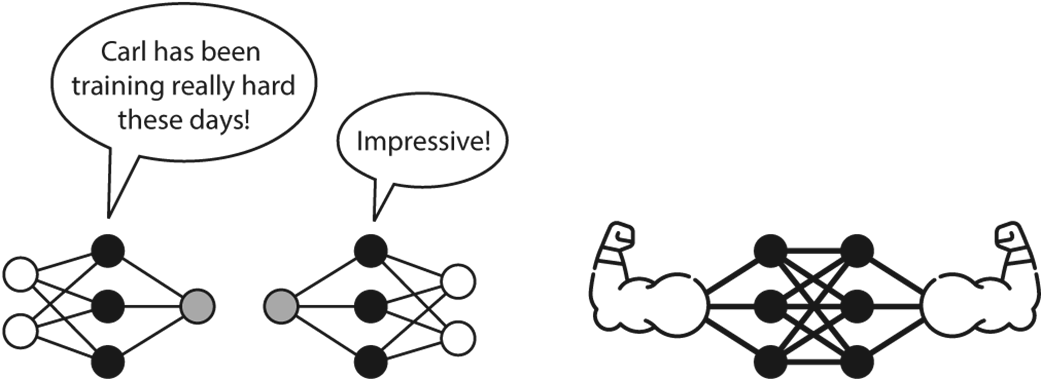
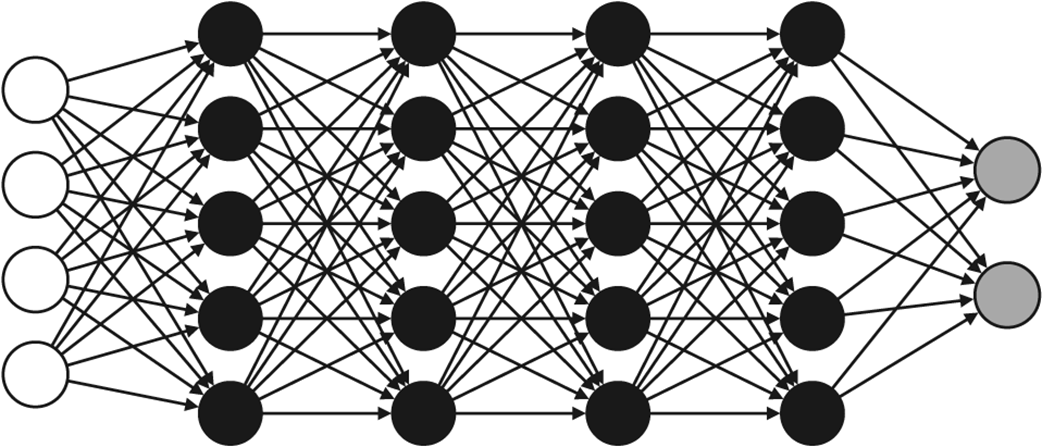
In this chapter, we learn neural networks, also called multilayer perceptrons. Neural networks are one of the most popular (if not the most popular) machine learning models out there. They are so useful that the field has its own name: deep learning. Deep learning has numerous applications in the most cutting-edge areas of machine learning, including image recognition, natural language processing, medicine, and self-driving cars. Neural networks are meant to, in a broad sense of the word, mimic how the human brain operates. They can be very complex, as figure 10.1 shows.

Figure 10.1 A neural network. It may look complicated, but in the next few pages, we will demystify this image.
Neural networks with an example: A more complicated alien planet

Solution: If one line is not enough, use two lines to classify your dataset

Why two lines? Is happiness not linear?

Combining the outputs of perceptrons into another perceptron

A graphical representation of perceptrons

A graphical representation of neural networks

The boundary of a neural network

The general architecture of a fully connected neural network

Training neural networks

Error function: A way to measure how the neural network is performing

Backpropagation: The key step in training the neural network

Potential problems: From overfitting to vanishing gradients

Techniques for training neural networks: Regularization and dropout

Different activation functions: Hyperbolic tangent (tanh) and the rectified linear unit (ReLU)

Neural networks with more than one output: The softmax function

Hyperparameters

Coding neural networks in Keras

A graphical example in two dimensions

Training a neural network for image recognition

Neural networks for regression

Other architectures for more complex datasets

How neural networks see: Convolutional neural networks (CNN)

How neural networks talk: Recurrent neural networks (RNN), gated recurrent units (GRU), and long short-term memory networks (LSTM)

How neural networks paint paintings: Generative adversarial networks (GAN)

Summary

Exercises