Appendix B. Working with Avro, Protobuf and JSON Schema
B.1 Apache Avro
An Avro schema is composed of two main types: primitive and complex. The supported primitive types are null, boolean, int, long, float, double, bytes, and string. Complex types are records, enums, arrays, maps, unions, and fixed. For a complete description of primitive and complex types, see the Avro documentation at https://avro.apache.org/docs/current/spec.html#schema_primitive and https://avro.apache.org/docs/current/spec.html#schema_complex, respectively.
In this book, you’ll mostly work with the complex type of record as this corresponds to an object. You may also encounter a few examples using primitive values, but for the most part, we’ll stick with records. You’ll also use the union type, especially when working with the 'RecordNameStrategy` and TopicRecordName strategies. The union type is represented as an array and is very useful. Unions allow you to specify that a field may be of one or more types. You’ll see examples of union types in the following examples.
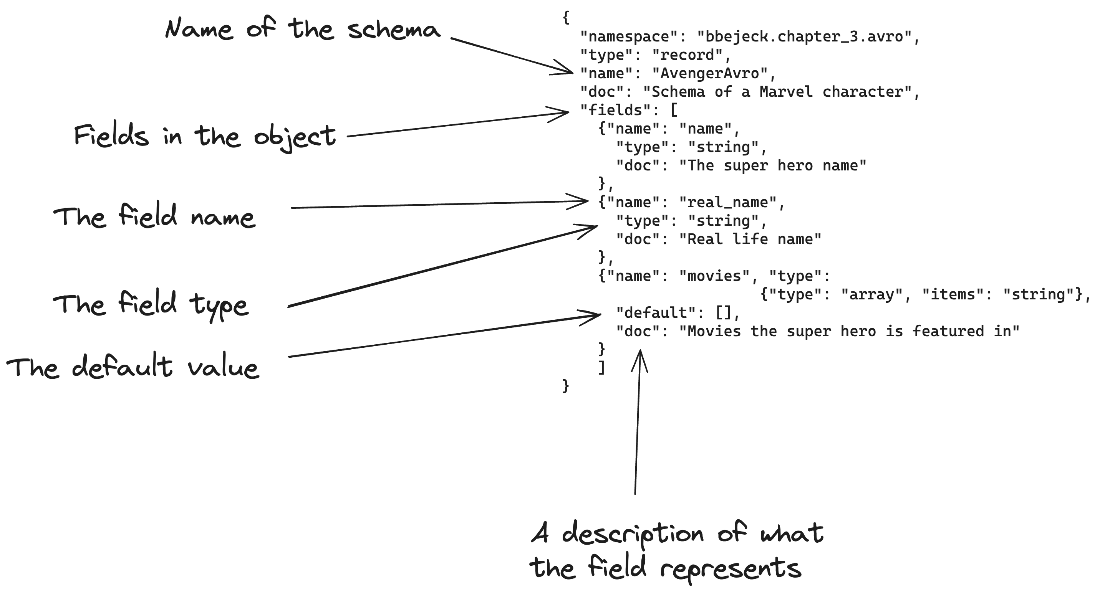
The record type contains the elements name, doc, aliases, and fields. The fields element can have the properties name, type, doc, default, order, and aliases. Let’s take a look at an Avro schema with some descriptions of what each of these properties is
By default, when serializing records, Avro encodes fields in the listed order of the schema.
I want to discuss the default and aliases from the abovementioned properties.