17 Flow operators
This chapter covers
- Operators used to transform and work with flows
- Intermediate and terminal operators
- Building custom flow operators
17.1 Manipulating flows with flow operators
In the previous chapter, you have gotten to know flows as the higher-level abstraction that allows you to work with multiple, sequential values over time while leveraging Kotlin’s concurrency machinery. In this chapter, we’ll discuss how to manipulate and transform them. You’ve already seen that Kotlin provides a vast selection of operators that you can use to manipulate collections (as we’ve discussed in Chapter 5 and Chapter 6). Likewise, you can use operators to transform flows.
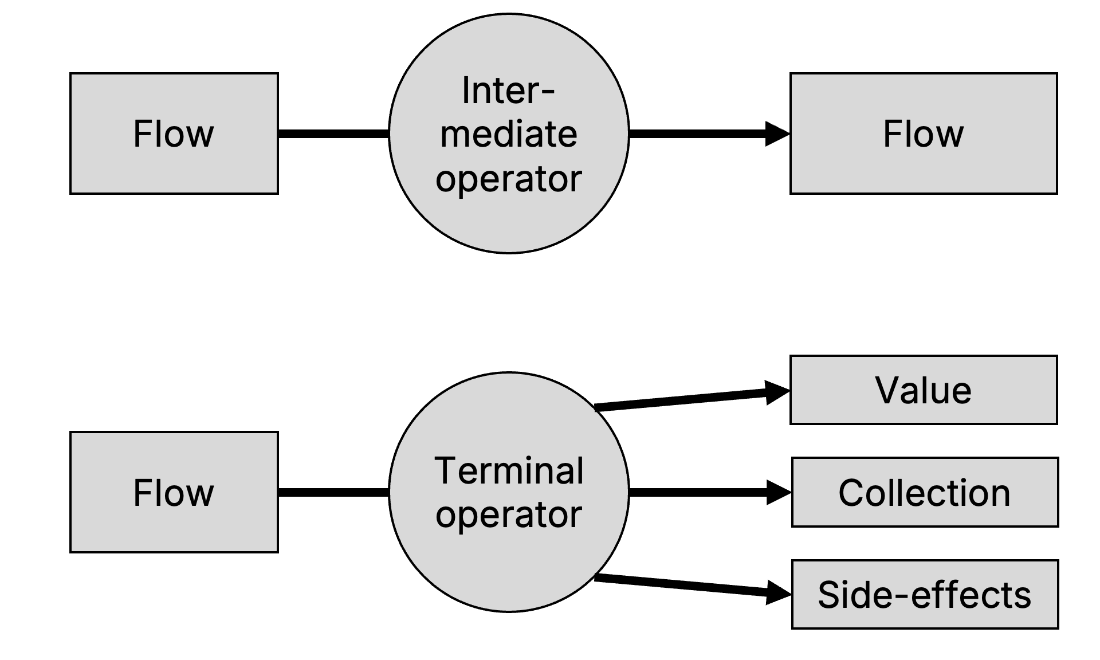
Just like with sequences, you distinguish between the intermediate flow operators and terminal flow operators, analogous to our discussion in Section 6.2.1: Intermediate operators return another, modified flow, without actually running any of the code yet. Terminal operators return a result – like a collection, an individual element from the flow, a computed value, or no value at all – collecting the flow and executing the actual code.
Figure 17.1 You distinguish between intermediate and terminal flow operators. Where intermediate operators return a modified flow, terminal operators return an actual result. They do so by executing the code in the flow.