concept capacity in category agile

This is an excerpt from Manning's book Becoming Agile ...in an imperfect world.
Table 8.4. Acme outlines a Feasibility phase for its new process. The new feasibility process accelerates evaluation and gets work started more quickly on urgent projects.
Step
Feasibility phase
Group(s)
Change notes
1 Submit idea to request site. Any employee In the past, ideas were only submitted by Marketing, Sales, or Product Management. Ideas don’t need detailed requirements to be submitted now. The new online form requires minimal population of fields to be accepted. 2 Review queue, and assign features for investigation. Product manager, line managers, or executive team Ideas can be approved for more detailed investigation (feasibility) by managers at any time. Managers decide if a team is needed to help with the research. 3 Research ideas for feasibility. Requestor, or feasibility team In the past, we only used the requestor’s information to determine if an idea was feasible. The team uses the Feasibility Discussion Guide to lead investigative work. (This guide is covered in chapter 10.) The team returns with information such as customer thoughts, information about what the competition is doing, cost/benefit analysis, key risks, time estimates, and main benefits to the customer. The feasibility team creates an elevator statement (covered in chapter 10). 4 Review findings to see if the idea should continue to the Planning phase. Product manager, line managers, or executive team Managers can send an idea on to planning. This is possible because 50% of the team’s capacity is now reserved for unscheduled projects. The other 50% of the capacity is reserved to support projects that come out of the quarterly planning process. A manager can escalate the decision to the executive team if funds are needed or if the project will exceed the remaining capacity in the quarter. 5 Decide to approve, cancel, or defer the idea/project. Product manager, line managers, or executive team Make the call about whether to continue and assemble a project team. 6 Assign resources to the planning team. Product manager, line managers, or executive team We want the planning team to stay with the project throughout development.
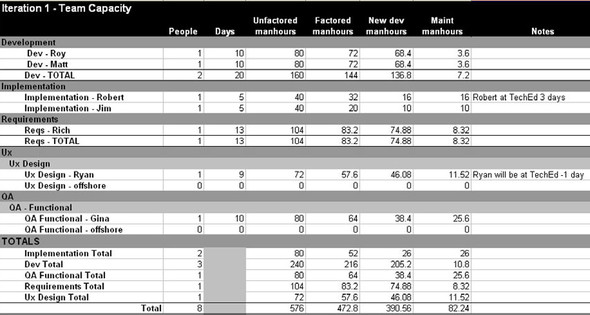
The first step in determining iteration capacity is looking at how many hours are available in an iteration. Advanced teams will measure hours available for the whole team. Teams new to agile will measure hours available by specialization. When you first move to agile, you probably won’t have interchangeable team members; instead, you’ll have people with development skills, analyst skills, HTML skills, database skills, and other specializations. Over time, the team should cross-train and lose dependency on specific people for specific tasks; but on day one, specialization will probably be a reality, and you must plan capacity around that reality.