concept developer in category agile

This is an excerpt from Manning's book Agile Metrics in Action: How to measure and improve team performance.
A developer might think that good means a well-engineered piece of software.
SCM is where the action is; that’s where developers are checking in code, adding reviews, and collaborating on solutions. I’ve often been on teams where it was like pulling teeth to get developers to move cards or add comments in the project tracking system, which ends up leading to a huge blind spot for anyone outside the development team interested in the progress of a project. You can eliminate that blind spot by looking at the data generated by the use of your SCM.
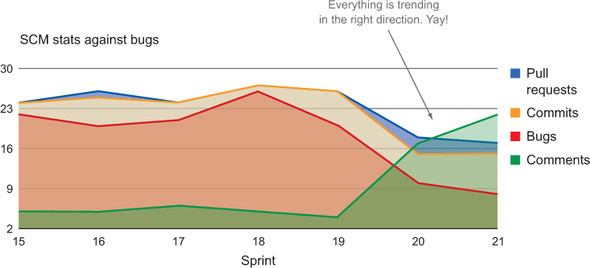
Figure 4.21 shows that there weren’t many comments along with the pull requests, which implies there wasn’t much collaboration going on. Because the bug trend wasn’t changing, it looked like the changes to their process weren’t having any effect yet. The workflow itself wasn’t producing the change the development team wanted; they needed to make a bigger impact on their process. To do this they decided that developers should act like the QM team when they were put on a pull request. The perspective they needed wasn’t just “is this code going to solve the problem?” but “is this code well built and what can go wrong with it?” There was some concern about developers accomplishing less if they had to spend a lot of time commenting on other developers’ code and acting like the QM team. They moved one of their QM members over to the development team as a coach, and the team agreed that if this would result in fewer bugs then the effort spent up front was time well spent. They started taking the time to comment on each other’s code and ended up iterating quite a bit more on tasks before checking them in. A few sprints of this process resulted in the graph shown in figure 4.22.
Figure 4.22 shows that as collaboration between development and quality increased—in this case shown through comments in pull requests—the number of bugs went down. This was great news for the team, so they decided to take the process one step further. The development managers brought in another member of the QM team to work with the developers on code reviews and quality checks to avoid throwing code over the wall to the whole QM team.
A common practice in teams that use DVCSs is the idea of a pull request. When a developer has a change or a set of changes that they want to merge with the master codebase, they submit their changes in a pull request. The pull request includes a list of other developers who should review the request. The developers have the opportunity to comment before giving their approve/deny verdict. This is illustrated in figure 4.5.

This is an excerpt from Manning's book Becoming Agile ...in an imperfect world.
Business people and developers must work together daily throughout the project. This principle is careful to say business people and not the customer. In most cases, it would be impractical to work with the customer on a daily basis; but generally there are multiple business proxies. These proxies may not know everything about the customer’s wants and needs, but they usually know more about the business needs than the developers do. These proxies may be analysts, product managers, or program managers. The key is to maintain constant communication between the developers and the business people to ensure that the project never goes off track—not even for a day.
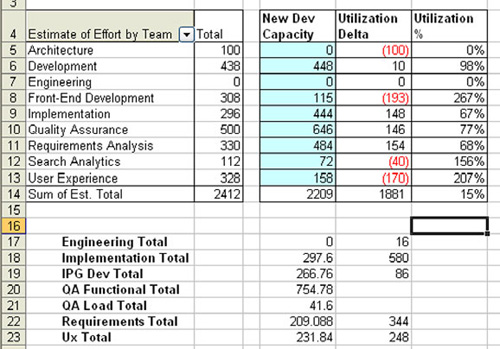
Figure 16.8. The team can compare capacity to estimates as they add features into the iteration. In this example, the features assigned to the iteration are almost perfect for the developers, pushing them to 98% of their capacity. But the user experience group is booked way beyond their capacity at 207%. The team can back out features to get everyone closer to 100%, or they can disregard the calculation and choose to go forward if they feel comfortable doing so.
Have business people and developers work together daily throughout the project.
In Acme Media’s previous process, the business analysts worked with the customer to document requirements. Frequently, an internal product manager communicated the needs. After the requirements were documented, the analyst passed them to the developer and determined whether there were any questions.
In Acme Media’s new process, the developers have already had direct interaction with the customer. The entire team participated in the feature-card exercise, and the developers gained clarity on some customer needs by asking questions directly. The customer (in this case, the product manager) will also be available during the development iterations and can clarify their needs and be consulted if issues are encountered.