concept end in category agile
appears as: end, The end

This is an excerpt from Manning's book Becoming Agile ...in an imperfect world.
Agile processes promote sustainable development. The sponsors, developers, and users should be able to maintain a constant pace indefinitely. In traditional development, the team often has to work late toward the end of a project, although at the beginning of the project they may have taken 2-hour lunch breaks. This is primarily due to the way project activities are distributed across the project’s lifecycle. There isn’t much for developers to do at the beginning of the project, but at the end everything is put on their shoulders because of tight delivery schedules. With agile development, you deliver every two weeks or so, and development begins with the first iteration. Efforts are distributed more consistently throughout the project lifecycle, which leads to a constant development pace for the team.
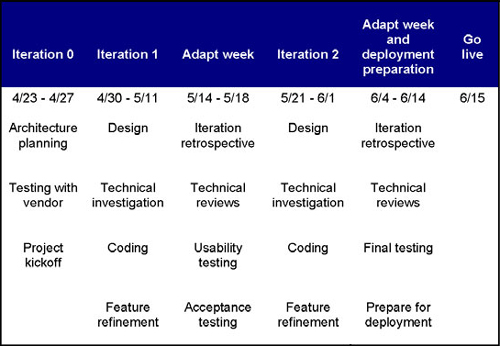
If we adapt all the time, how do we get any work done? This is a superb question. Many anti-agile folks want to know how we get any work done if we spend all our time talking about it instead of doing it. That is a fair question. The answer is that there is a fine line between work labeled adapting and work labeled development. Are you adapting when you’re stuck on a technical constraint and you’re Googling for a workaround? Are you performing development when you refine requirements with a customer or analyst? At the end of the day, it’s all work that supports delivering the correct solution to the customer. This will be demonstrated in sections 20.2 and 20.3. How do we adapt at the end of an iteration? We’ll cover this question in section 20.3. Acme Media will demonstrate a solid process for gathering feedback at the end of an iteration and recalibrating the project based on the customer response.