concept principle in category agile

This is an excerpt from Manning's book Agile Metrics in Action: How to measure and improve team performance.
When you send someone an email, it should contain just the information they need now. Going back to the principle of showing people only what they can affect, keep your emails to a few key metrics that recipients can take direct action on if they choose to. At the same time, perhaps they’d like to dig deeper or see more data. In this case, instead of continually adding more data to email reports, add it to the dashboard and reference the dashboard in your email.
The next step is to use the data you’ve been collecting throughout the book to answer your questions. Using the high-level questions fleshed out previously, you can start breaking the principles into categories in order to measure them. If you look at each agile principle in detail, you’ll start to see that of the twelve principles three imply measuring software, four implicate teamwork, four represent process, and one references requirements. Let’s start off with aligning the principles with the delivery lifecycle.
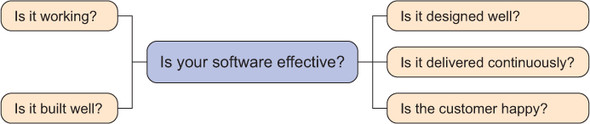
Let’s start with a mind map to align the principles with the big question you’re trying to answer, as shown in figure 10.4.
If you take keywords from each of the principles and transpose them over the delivery lifecycle that you’ve been looking at in previous chapters, you can see where to get the data you need to measure them, as shown in figure 10.3.