concept time in category agile

This is an excerpt from Manning's book Agile Metrics in Action: How to measure and improve team performance.
Velocity —The relative performance of your team over time Changed lines of code (CLOC) —The number of lines of code that were changed over time
Perhaps the most obvious place to find data that points to your team’s performance is your PTS. Common PTSs include JIRA, Trello, Rally, Axosoft On Time Scrum, and Telerik TeamPulse. This is where tasks are defined and assigned, bugs are entered and commented on, and time is associated with estimates and real work. Essentially your project’s PTS is the intersection between time and the human-readable definition of your work. Figure 3.1 shows where this system lives in the scope of your application delivery lifecycle.
Estimating how long tasks will take can be pretty tricky in an agile world. It can be tough to figure out how long something can take when definitions are often in flux and products are constantly changing. Estimates are important from a project management perspective because they will eventually allow you to predict how much work you can get done in a certain amount of time. They also show you if your team really understands the work that they’re doing.
One thing that seems to always challenge teams is what estimations mean. Story points are supposed to relate to effort, yet every team I’ve ever been on ends up translating those points to time, so in most cases I find it easier for teams to use a time-based estimation. There are a plethora of blogs, articles, and chapters on the association of time and story points, but if there’s one thing I’ve learned it’s this: embrace whatever comes most naturally to your team. If your team estimates in time, then use days or half-days as story points. If they like the concept of effort, then go with it. If you try to fight whatever people understand as estimates, you’ll end up with numbers whose relativity constantly changes as you try to change their association of time to estimations. By embracing what comes naturally to your team, you may not end up with a textbook way of estimating your tasks, but you will end up with more reliable data over time.
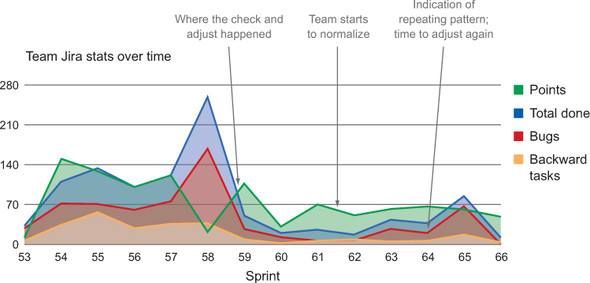
For teams I’ve managed it normally takes three to four iterations before they can start to trust their estimations. The best way to see if your estimations are on track is to look at them over time next to the total number of tasks that you complete over time.
Even if you get to a point where your estimations and completed work are consistent, using estimations alone can’t tell you if you are under- or overestimating. Overestimating work means your team is underachieving for some reason; underestimating typically leads to team burnout and an unsustainable pace of development. The tricky thing here is that estimations alone don’t give you that insight into your team; you have to combine estimations with other data to see how well your team is estimating. Figure 3.8 may look great to you if you’re trying to hit a consistent goal over time.

This is an excerpt from Manning's book Becoming Agile ...in an imperfect world.
All software projects have constraints. Similar to the situation during the Quecreek rescue, the number-one constraint is frequently time. The Quecreek rescue team had a few days to reach the miners. Software projects are often limited to a few days, weeks, or months, after which they’re of no value. Like a Sunday newspaper delivered on Monday, all the quality work and effort invested in the project are worthless if you don’t meet your most critical priority.
In the past, Acme Media delivered all software, both high- and low-priority features, in one delivery at the end of the project. The entire team didn’t help during development; it was solely up to the programmers to bring the features home. In this chapter, Acme will use its new iterative approach and deliver the highest-value features first. The team will deliver working software in batches until they run out of time or the customer need is satisfied.
When we left Acme Media, the team had just completed their iteration plan. They outlined one item for iteration 0, modifying the contract with eLertz to support an additional alert needed for the Auctionator. With this work out of the way, it’s time to focus on the features that are assigned to iteration 1.
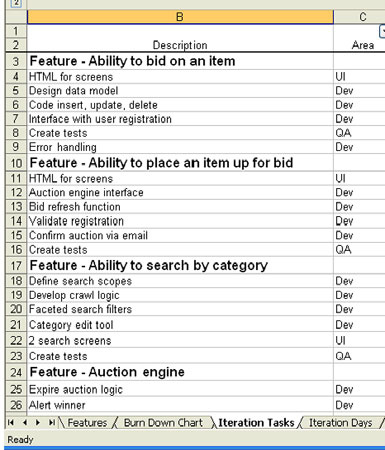
Figure 18.1. Acme Media’s backlog of work for iteration 1. In a perfect world, team members grab a task and begin working. In Acme Media’s world, the team is constrained by specializations, and some tasks can be completed only by certain team members or groups. Acme Media will cross-train, but it will take time for the team to mature to a point of no specializations.