concept analysis in category AI

This is an excerpt from Manning's book Succeeding with AI: How to make AI work for your business.
Action is where you make profit; analysis without action is just cost. You make money when you perform an appropriate business action, not when some analysis is completed. Analysis can be an enabler of making profits, but from an accounting perspective, analysis is a cost. Analysis stops being a cost and becomes an investment only when it can help you take good business actions.
An analysis must be cheap to perform. It must balance the cost of analysis (cost of asking the questions) with the value of knowing the answer. This balance is what D. W. Hubbard [75] refers to as the expected value of perfect information [79].
Analyzing an ML pipeline is something you should repeatedly do for each AI project and for each ML pipeline you consider for each project. Even if you’re a nontechnical reader, spend the time now to understand how analysis works. The understanding you acquire will help you make the best decisions, not only for your current AI project, but for future projects as well. In chapter 8, I’ll show you that the methods you’ll learn have a far broader application than simply an analysis of the ML pipeline.
Now that you know how to interpret the results of the MinMax analysis, let’s talk about how to perform the analysis. How did we get the numbers from the previous section that are the result of the MinMax analysis? By analyzing an ML pipeline. This section shows you how to perform such an analysis.
You analyze an ML pipeline by running data through it and then using a profit curve to measure the result in business terms. The general process for the analysis (figure 6.6) is the same for both the Min and Max part of the MinMax analysis, and even applies to the sensitivity analysis of the ML pipeline.
Figure 6.6. Analysis of an ML pipeline. This analysis tells you what the current ML pipeline can achieve for the business. Both the Min and Max part of the MinMax analysis use the same process.
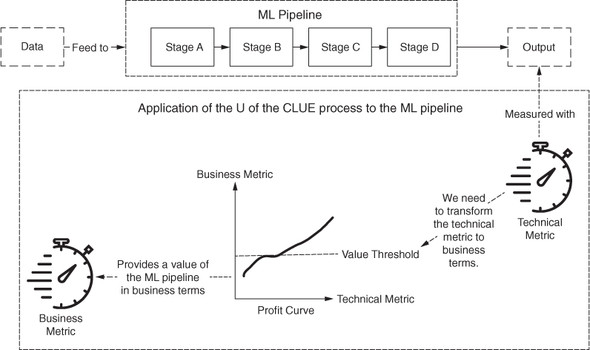
The analysis shown in figure 6.6 measures the results of the ML pipeline in business terms. That’s done by processing real data with your current ML pipeline, measuring the output using technical metrics, and then transforming that value into the business metric. Another way to think about this analysis is that you’re feeding the ML pipeline with real data and are then applying the Understand part of the CLUE process to measure the result.