concept each particle in category AI

This is an excerpt from Manning's book Grokking Artificial Intelligence Algorithms.
Initialize the population of particles. Determine the number of particles to be used, and initialize each particle to a random position in the search space.
Calculate the fitness of each particle. Given the position of each particle, determine the fitness of that particle at that position.
Calculate the fitness of each particle. Given the position of each particle, determine the fitness of that particle at that position.
Update the position of each particle. Repetitively update the position of all the particles, using principles of swarm intelligence. Particles will explore the search space and then converge to good solutions.
Update the position of each particle. Repetitively update the position of all the particles, using principles of swarm intelligence. Particles will explore the search space and then converge to good solutions.
Determine the stopping criteria. Determine when the particles stop updating and the algorithm stops.
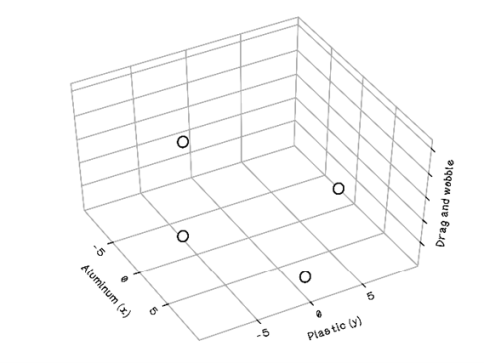
Starting position for each particle—The starting position for each particle should be a random position in all the respective dimensions. It is important that the particles are distributed evenly across the search space. If most of the particles are in a specific region of the search space, they will struggle to find solutions outside that area.
Starting velocity for each particle—The velocity of particles is initialized to 0 because the particles have not been affected yet. A good analogy is that birds begin takeoff for flight from a stationary position.
Starting velocity for each particle—The velocity of particles is initialized to 0 because the particles have not been affected yet. A good analogy is that birds begin takeoff for flight from a stationary position.
Figure 7.15 A visualization of the initial positions of four particles in a 3D plane