concept user in category AI

This is an excerpt from Manning's book AI-Powered Search.
Furthermore, while not too long ago the expected response from a search box may have been simply returning "ten blue links" - a list of ranked documents for a user to investigate to find further information in response to their query - expectations for the intelligence-level of search technologies have sky-rocketed in recent years.
Every time a customer takes an action - whether it be issuing a query, clicking on a result, purchasing a product, or otherwise taking some action on the search results - this provides a signal of that user’s intent. We can log each of these signals and then process them in order to learn insights about each user, about groups of users, and about an entire user base. This section will introduce you to the power of leveraging user signals, introduce a sample ecommerce dataset we will use throughout the book, and walk you through the mechanics of collecting, storing, and processing the user signals.
Figure 4.2. Reflected Intelligence Process. A user issues a query, sees results, and takes a set of actions. Those actions (signals) are then processed to create learned relevance models that improve future searches.
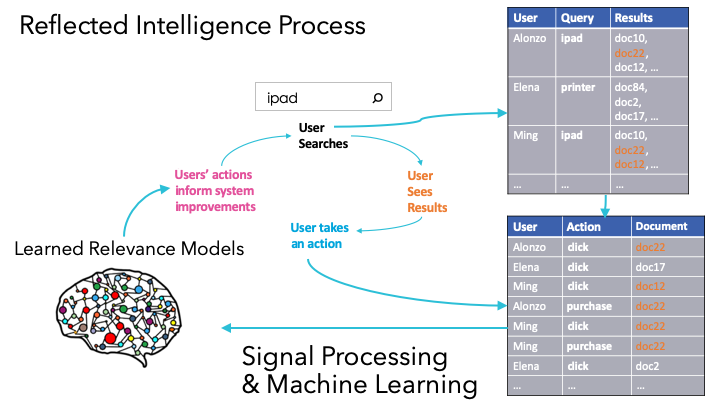
Let’s walk through the Reflected Intelligence process shown in Figure 4.2. A user named Alonzo runs a search, entering the term ipad in the search box. A query signal is logged, containing the list of all search results displayed to Alonzo. Alonzo then sees the list of search results, and takes some actions. In the figure, Alonzo clicks on a document (
doc22) and then purchases the product that document represents, resulting in two additional corresponding signals. All of Alonzo’s signals, along with the signals from every other user, can then be aggregated and otherwise processed by various machine learning algorithms to create learned relevance models.

This is an excerpt from Manning's book Zero to AI: A non-technical, hype-free guide to prospering in the AI era.
Google has always been a leader in PUE efficiency: According to the a 2018 survey of the Uptime Institute among 900 DC operators, the average PUE in the industry in 2018 is 1.58; Google continuously improved its PUE until it reached 1.12 in 2013. Unfortunately, this value hasn’t improved until 2017.
Our real estate example has served us well so far, but you’re likely wondering how Recommender Systems can be adapted to other types of items, such as the clothes in your favourite e-shop. When talking about homes, we were lucky to have a set of descriptive features that were also reasonably easy to collect. Again, those are the same features that we used in Chapter 2 to predict the sales price of the home.
However, many organizations deploy Recommender Systems on catalogs of items for which it’s much harder to select features. Imagine the example we started the chapter with: finding the best t-shirt for you. What kind of features we may use?
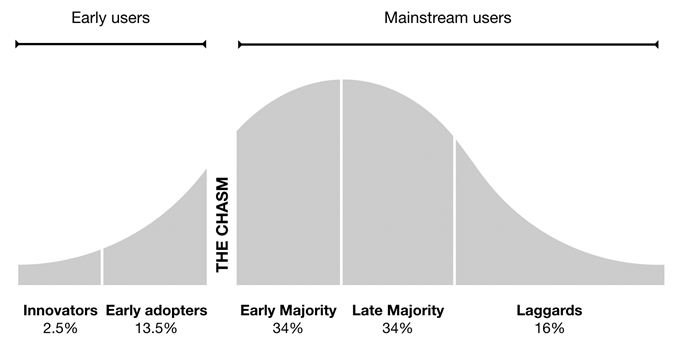
Figure 9.11: The market for a technological innovation divided into its five different customers groups. After the early adopters there’s the chasm: a moment of high uncertainty when switching from early to mainstream users.

This is an excerpt from Manning's book Succeeding with AI: How to make AI work for your business.
It’s up to you as the user of the algorithm to understand which evaluation metric is best and what the best format is for your data. Figure 1.2 shows the roles that humans and computers play in ML.
The ML pipeline describes how data flows through the system, what high-level transformation is done on it, which ML and AI algorithms are applied, and how the results are presented to the user of your AI system. Without a focus on the pipeline’s architecture, your project would be saddled with an ML pipeline that emerges from early proof-of-concept (POC) decisions. That’s not good, because an ML pipeline quickly ossifies and becomes difficult and costly to radically change.
Every AI project uses some form of the ML pipeline. That pipeline starts by collecting data and finishes by presenting results. The ML pipeline is one of the primary determinants of how the user will perceive the system as a whole.