concept select in category ajax

This is an excerpt from Manning's book Ajax in Action.
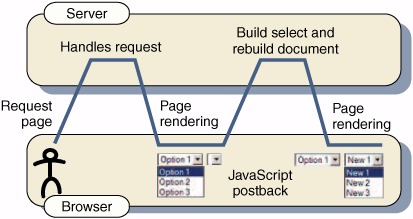
The next traditional solution is the submission of a form back to the server, which is known as a page postback. In this method, the onchange event handler in the first selection list triggers a postback to the server, via the submit() method of the form’s JavaScript representation. This submits the form to the server, transmitting the user’s choice from the first select element. The server, in turn, queries a database based on the value that the user selected, and dynamically fills in the new values for the second list, as it re-renders the page. You can see the process of the server-side method in figure 9.2.
A drawback to the server-side method is the number of round-trips to the server; each time the page is reloaded, there is a time delay, since the entire page has to re-render. Figure 9.2 shows all of the extra processing required. Additional server-side code is also needed to reselect the user’s choice on the first select element of the re-rendered page. Moreover, if the page was scrolled to a particular spot before the form was submitted, the user will have to scroll back to that location after the page reloads.
The first thing to do is to set up the first selection list to allow multiple items to be chosen. To do this, we need to add the multiple attribute to the select tag. To specify how many options to display, we can add the size attribute. If size is smaller than the number of options, the selection list will be scrollable to reveal those that are not visible.
<select name="ddlRegion" multiple size="4"
  onchange="FillTerritory(this,document.Form1.ddlTerritory)">
  <option value="1">Eastern</option>
  <option value="2">Western</option>
  <option value="3">Northern</option>
  <option value="4">Southern</option>
</select>
Let’s assume that we may not be able or want to directly change the HTML markup for the select boxes. This could be the case if we are not responsible for producing the markup. Perhaps the select is generated by a JSP or other server-language-specific tag. Or perhaps a designer is writing the HTML, and we want to keep it as pristine as possible to avoid major reworks caused by a round or two of page redesigns.