concept Erlang in category akka
This is an excerpt from Manning's book Reactive Design Patterns.
Over the past 30 years, people have designed many tools and paradigms to help build Reactive applications. One of the oldest and most notable is the Erlang programming language (www.erlang.org), created by Joe Armstrong and his team at Ericsson in the mid-1980s. Erlang was the first language that brought Actors, described later in this chapter, into mainstream popularity.
Armstrong and his team faced a daunting challenge: to build a language that would support the creation of distributed applications that are nearly impervious to failure. Over time, Erlang evolved in the Ericsson laboratory, culminating with its use in the late 1990s to build the AXD 301 telephone switch, which reportedly achieved “nine nines” of uptime—availability 99.9999999% of the time. Consider exactly what that means. For a single application running on a single machine, that would be roughly 3 seconds of downtime in 100 years!
100 years
    * 365 days/year
    * 24 hours/day
    * 60 minutes/day
    * 60 seconds/minute
        = 3,153,600,000 seconds

3,153,600,000 seconds
    * 0.000000001 expected downtime
        = 3.1536 seconds of downtime in 100 years
Of course, such long-lasting, near-perfect uptime is purely theoretical; modern computers haven’t even been around 100 years. The study upon which this claim was based was performed by British Telecom in 2002–2003 and involved 14 nodes and a calculation based on 5 node-years of study.[1] Such approximations of downtime depend as much on the hardware as on the application itself, because unreliable computers put an upper limit on the availability of even the most resilient software. But such theoretical uptime illustrates the extraordinary fault tolerance possible in a Reactive application. Amazingly, no other language or platform has made claims comparable to Erlang’s.
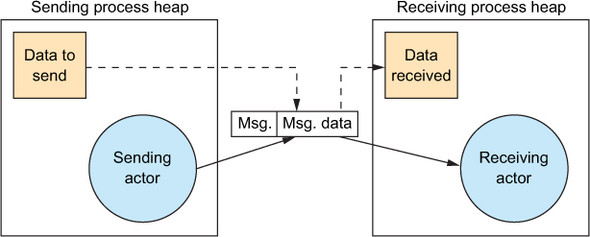
Erlang employs a dynamic type system and ubiquitous pattern matching to capture the dynamic nature of Actor systems, and it copies message data for every message it passes between Actors. The data has to be copied as shown in figure 3.1 because there is no shared heap space between two Actor processes in the BEAM VM, the virtual machine on which Erlang runs. Data sent between Actors must be copied into the receiving Actor process’s heap prior to sending the message, to guarantee isolation of Actors and to prevent concurrent access to the data.
Most implementations of Actors support organization into supervisor hierarchies to manage failure at varying levels of importance. When an exception occurs inside an Actor, that Actor instance may be resumed, restarted, or stopped, even though the failure occurred on a different asynchronous thread. Erlang’s Open Telecom Platform (OTP, https://github.com/erlang/otp) defines a pattern for building supervision hierarchies for Actors, allowing a parent Actor to manage failure for all children below it, possibly elevating some failures to an appropriate “grandparent” Actor.