concept ownership in category akka
This is an excerpt from Manning's book Reactive Design Patterns.
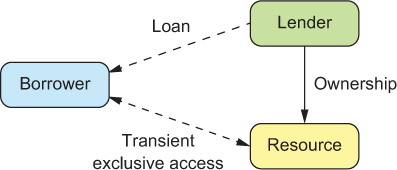
It does not make sense to replicate the same functionality in multiple places. We would like to solve each problem only once, in source code as well as in deployment and operations. Notice that none of the modules we mentioned owns the contacts functionality. It is not a core concern of any of them. Ownership is an important notion when it comes to decomposition. In this case, the question is, who owns which part of the problem space? There should be only one module that is responsible for any given functionality, possibly with multiple concrete implementations; all other modules that need to access that functionality have a dependency on the module that owns it.
The importance of ownership appeared already within the decomposition of a system according to divide et regna, expressed as the difference between a descendant module and a dependency. Descendants own a piece of the parent’s functionality, but foreign functions are incorporated only by reference. The resulting hierarchy gives the supervision structure for the modules.
If a certain piece of the problem is owned by a module, that means this module needs to solve that part and provide the corresponding functionality. No other module will do so in its stead. Dependent modules will rely on this fact and will not operate correctly or to their full feature set when the module that is supposed to offer these functions is not operational. In other words, ownership of a part of the problem implies a commitment to provide the solution, because the rest of the application will depend on this.