concept Resource Loan pattern in category akka

This is an excerpt from Manning's book Reactive Design Patterns.
A variant of the Resource Loan pattern is widely used in non-Reactive systems, the most prominent example being that of a database connection pool. Database access is represented by a connection object via which arbitrary operations can be performed. The creation of connections is expensive, and their number is limited; therefore, a connection is not owned by client code but is taken from a pool before performing an operation and put back afterward. The connection pool is responsible for managing the lifecycle of its connections, and client code obtains temporary permission to use them. Failures in this scenario are communicated to the client, but their effect on the connection in question is handled by the pool—the pool owns and supervises the connections.
The individual messages that are exchanged are small building blocks from which this interchange is built. The purpose of the Resource Loan pattern is to allow the lender to be largely unaware of this protocol, which is only shared by the borrower and the resource, as shown in figure 14.1.
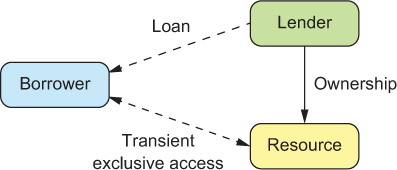
The mechanics for handing out a subcomponent to an external client can also be used to expose part of a component’s functionality or data. Imagine a component that holds a large, multidimensional array of floating-point numbers resulting from the analysis of a huge amount of data. Clients may be interested in particular slices of the array but are not allowed to make changes. Using the Resource Loan pattern, the component can offer a protocol for obtaining a handle to a particularly shaped slice of the data for read-only access. The client invokes methods on this handle to obtain particular values, wrapped in a Future. This allows the implementation to decide how many of the referenced values to ship to the client immediately and how to retrieve the rest when the client eventually asks for them—imagine a slice big enough to cause considerable network usage if it were transferred up front.
By using the Resource Loan pattern, the component that manages the multidimensional array knows exactly how many read-only handles are currently active, and it can invalidate them when needed. For example, only a limited number of snapshots can be kept in memory—with clients having handles to them—and when further changes need to be made, the oldest snapshot will be retired to free up its space.