concept context in category alexa

This is an excerpt from Manning's book Voice Applications for Alexa and Google Assistant.
These people gave you the right amount of information for your inquiry, asked follow-up questions if something wasn’t clear, and considered the context around you in the conversation. Asking for the restrooms doesn’t require an answer that tells you there are restrooms on the first, third, fifth, and sixth floors, and that there used to be restrooms on the second floor but they are closed for the next month.
Alexa responds with how much time that user slept. The context being used here is the knowledge of the user’s bedtime and the fact that the conversation is about the user waking up. As far as context goes, this is a good start. The user still has to respond directly to what Alexa said. In fact, the main unspoken subject (“Are you up for good?”) is spoken by Alexa, not the user.
Listing 6.1 Intents for getting the name and asking for spelling (./models/en-US.json)
...
"intents":[
    {
      "name":"GetNameIntent",
      "slots":[
        {
          "name":"name",
          "type":"AMAZON.US_FIRST_NAME"    #1
        }
      ],
      "samples":[
        "{name}",    #2
        "the name is {name}",    #2
        "{name} is the name",    #2
        "facts about the name {name}",    #2
        "facts about {name}"    #2
      ]
    },
    {
      "name":"SpellingIntent",
      "slots":[
        {
          "name":"name",
          "type":"AMAZON.US_FIRST_NAME"
        }
      ],
      "samples":[
        "what is the spelling of {name}",
        "what the spelling of {name} is",
        "{name} spelling",
        "how to spell {name}",
        "what is the spelling of it",    #3
        "what is the spelling",    #3
        "what the spelling is",    #3
        "how do you spell it",    #3
        "how it is spelled",    #3
        "spelled out",    #3
        "spelling"    #3
      ]
    },
    ...
  ]
  ...

#1   Biases toward US names and pronunciations
#2   All the samples collect a name.
#3   Some samples don’t include a name and rely on context.
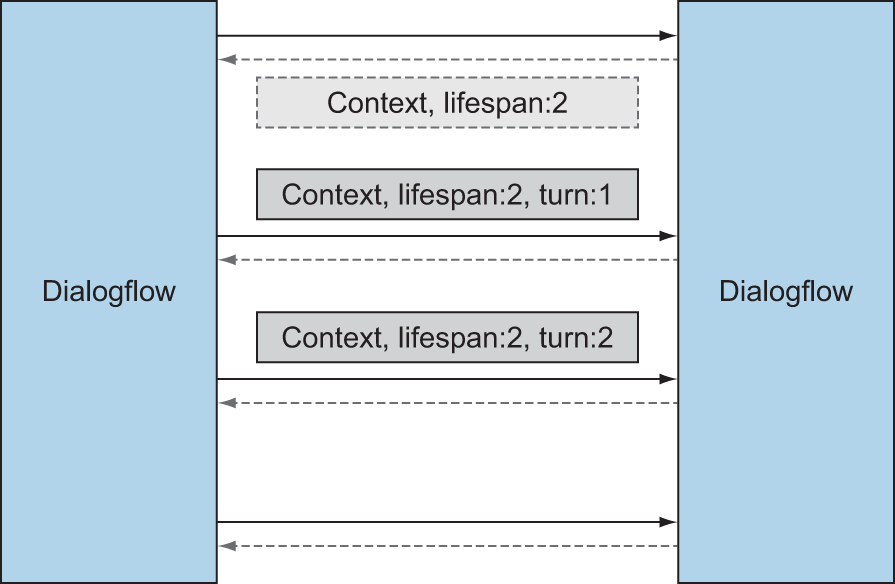
Figure 11.3 Dialogflow passes context between its platform and the fulfillment.