concept application in category algorithms

This is an excerpt from Manning's book Algorithms and Data Structures in Action.
Section 2.7 and 2.8 will describe use cases where heaps and priority queues make a difference and allow speeding up applications or other algorithms.
Figure 2.19 Explaining how to read an example boxplot. Boxplots show the distribution of samples using a nice and effective chart. The main idea is that the most relevant samples are those whose values lie between the first and third quartile, i.e. we find 3 values, Q1, Q2 (aka the median), and Q3 such that:
25% of the samples are smaller than Q1;
50% of the samples are smaller than Q2 (which is the very definition of median, by the way);
75% of the samples are smaller than Q3.
The box in the boxplot is meant to clearly visualize the values for Q1 and Q3.
Whiskers, instead, shows how far from the median the data extends. To that goal, we could also display outliers, i.e. samples that are outside the whiskers’ span. Sometimes outliers, though, end up being more confusing than useful, so in this example we will not use them.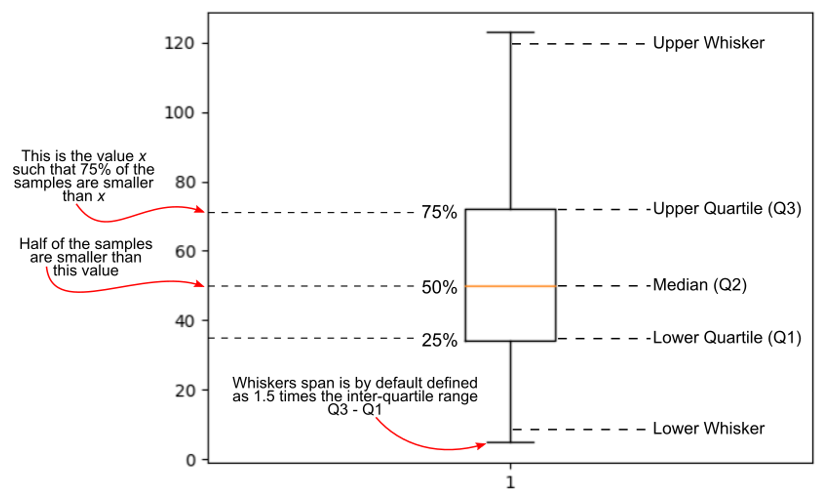
In our daily job as software developers, we daily write applications, most of which perform really simple tasks most of the time. Adding two numbers, or even dividing them or adding two vectors (with modern GPU[1]s) are trivial operations, fast enough that we don’t need to bother about optimizing them (of course this wasn’t always the case: but if you happen to be young enough, you never had to deal with x86 processors…).
Listing 11.6 A curried version of hasItemX
function hasItem(item, node)                        #1
  return item in node.shop.items                        #2

nn = fNN(root, customerLocation, hasItem(X))#3

This is an excerpt from Manning's book Algorithms and Data Structures for Massive Datasets.
One of the central consequences of the rapid growth of data, and the main idea motivating algorithms in this book, is that most applications today are data-intensive. Data-intensive (in contrast to CPU-intensive) means that the bottleneck of the application comes from transferring data back and forth and accessing data, rather than doing computation on that data (in Section 1.4 of this chapter, there are more details as to why data access is much slower than the computation.) But what this practically means is it will require more time to get data to the point where it is available for us to solve the problem on it, than to actually solve the problem; thus any improvement in managing the size of data or improving data access patterns are some of the most effective ways to speed up the application.
In addition, the infrastructure of modern-day systems has become very complex, with thousands of computers exchanging data over network, databases and caches are distributed, and many users simultaneously add and query large amounts of content. Data itself has become complex, multidimensional, and dynamic. The applications, in order to be effective, need to respond to changes very quickly. In streaming applications[3], data effectively flies by without ever being stored, and the application needs to the capture the relevant features of the data with the degree of accuracy rendering it relevant and useful, without the ability to scan it again. This new context calls for a new generation of algorithms and data structures, a new application builder’s toolbox that is optimized to address many challenges of massive-data systems. The intention of this book is to teach you exactly that --- the fundamental algorithmic techniques and data structures for developing scalable applications.