concept array in category algorithms

This is an excerpt from Manning's book Algorithms and Data Structures in Action.
It’s still high level, but clearer and more modular than the previous one.
Figure 2.4 A binary heap. Only priorities are shown for the nodes (elements are irrelevant here). In red, inside the small squares, you can the indices of the heap elements in the array.
Nodes are matched into array elements top-to-bottom, left-to-right.
Top: the tree representation for the heap. Notice how every parent is smaller (or at most equal) of its children and, in turn, all elements in its subtree.
Bottom: the same heap in its array representation.
Listing 3.3 Left Rotation
function lefttRotate(treap, x)                        #1
  if x == null or isRoot(x) then                        #2
    throw
  y ← x.parent                                #3
  throw-if y.right != x                            #4
  p ← y.parent                                #5
  if p != null then                                #6
    if p.left == y then                            #7
      p.setLeft(x)                                #8
    else
      p.setRight(x)
  else                                    #9
    treap.root ← x
  y.setRight(x.left)                            #10
  x.setLeft(y)                                #11
A set of k hash functions. The array is (conceptually) an array of bits, each of which is initially set to 0; each hash function outputs an index between 0 and m-1.

This is an excerpt from Manning's book Grokking Algorithms: An illustrated guide for programmers and other curious people.
The good news is, an implementation of every algorithm in this book is probably available in your favorite language, so you don’t have to write each algorithm yourself! But those implementations are useless if you don’t understand the trade-offs. In this book, you’ll learn to compare trade-offs between different algorithms: Should you use merge sort or quicksort? Should you use an array or a list? Just using a different data structure can make a big difference.
Let’s use quicksort to sort an array. What’s the simplest array that a sorting algorithm can handle (remember my tip from the previous section)? Well, some arrays don’t need to be sorted at all.
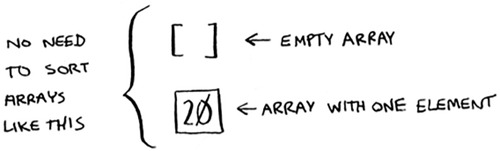
Empty arrays and arrays with just one element will be the base case. You can just return those arrays as is—there’s nothing to sort:
def quicksort(array):
  if len(array) < 2:
    return array
!@%STYLE%@!
{"css":"{\"css\": \"font-weight: bold;\"}","target":"[[{\"line\":0,\"ch\":0},{\"line\":0,\"ch\":3}],[{\"line\":1,\"ch\":2},{\"line\":1,\"ch\":4}],[{\"line\":2,\"ch\":4},{\"line\":2,\"ch\":10}]]"}
!@%STYLE%@!
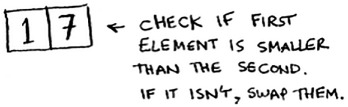
Let’s look at bigger arrays. An array with two elements is pretty easy to sort, too.
What about an array of three elements?
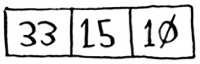
Remember, you’re using D&C. So you want to break down this array until you’re at the base case. Here’s how quicksort works. First, pick an element from the array. This element is called the pivot.

We’ll talk about how to pick a good pivot later. For now, let’s say the first item in the array is the pivot.