concept high dimension in category algorithms

This is an excerpt from Manning's book Algorithms and Data Structures in Action.
In section 8.2, we have showed that it is possible to efficiently solve the nearest neighbor problem in 1-D by using a binary search tree. If you read through the book and the appendices on core data structures, you should by now be familiar with binary trees. (If you did skip appendix C, this is your clue: go check out binary trees!).
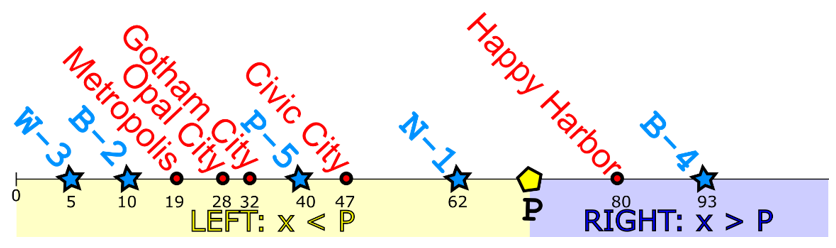
Figure 8.7 Real numbers on ℝ. Given a point P, the continuous line is naturally partitioned into a left (yellow) and a right (blue) subset.
Considering the random factor in this algorithm, however, this is clearly still a naïve search over the possible values of T2, and it could possibly lead to an infinite loop: to correct this situation, we could add a stop condition (and an argument) checking that a maximum number of iterations is not exceeded; at the same time, we could also store the result that is closest to our request in a temporary variable that we update at each run, and return this result whenever the maximum number of iterations is reached without finding a set of canopy with exactly numCentroids entries: most of the times it can be acceptable if we return, for instance, 101 centroids instead of 100 (the point being, the caller will anyway have the chance to check the result and decide).

This is an excerpt from Manning's book Grokking Artificial Intelligence Algorithms.
Search spaces with high dimensions—There is complexity in high dimensions. Many dimensions of a problem are required to find a good solution.