concept performance in category algorithms

This is an excerpt from Manning's book Algorithms and Data Structures in Action.
Obviously, your goal should not be remembering by heart all the details of all the data structures we will discuss. We will rather try to show you how to reason about issues, where to find ideas about algorithms that might help you in solving problems. This book will also serve as a handbook, sort of a recipe collection, with indications about some common scenarios that could be used to categorize those problems and the best structures you could use to attack them.
Table 7.1 Comparative analysis of performance vs implementation for cache with n elements
Array (unsorted)
Array (sorted)
Linked List
Hash Table
Balanced Tree
Storing an entry
O(1)
O(n)
O(n)
O(1)#
O(log n)
Finding entry by name
O(n)
O(log n) $
O(n)
O(1) #
O(log n)
Removing oldest entry
O(n) §
O(n)
O(1)
O(n)
O(log n)

This is an excerpt from Manning's book Grokking Artificial Intelligence Algorithms.
One scenario in which search algorithms are useful is being stuck in a maze and attempting to find the shortest path to a goal. Suppose that we’re in a square maze consisting of an area of 10 blocks by 10 blocks (figure 2.4). There exists a goal that we want to reach and barriers that we cannot step into. The objective is to find a path to the goal while avoiding barriers with as few steps as possible by moving north, south, east, or west. In this example, the player cannot move diagonally.
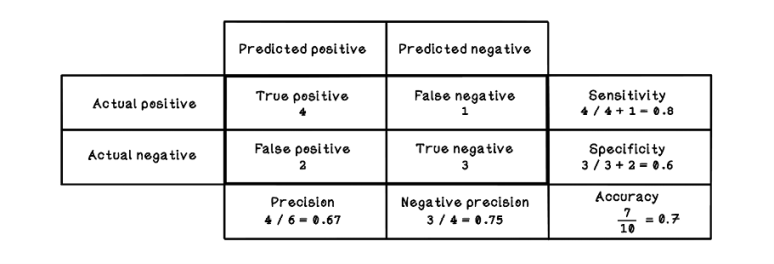
Figure 8.30 Confusion matrix for the diamond test example