concept population in category algorithms

This is an excerpt from Manning's book Algorithms and Data Structures in Action.
A genetic algorithm is an optimization meta-heuristic based on the principles of genetics and natural selection. We mentioned that this optimization technique maintains a pool of solutions: what we hadn’t said, is that these solutions will mimic a population that is evolved through several generations: each organism in the population is defined by a chromosome (or, sometimes, a pair of chromosomes), that encodes a single solution to the problem that’s optimized.
Figure 18.6 Elitism and thresholding illustrated with an example (0-1 knapsack problem). Elitism takes the best individual(s) (one or a few of the highest-fitness entries) and directly bring it to the next generation, without mating or mutations.
Thresholding takes care of the opposite problem: it’s a hard barrier that stops low-fitness individuals from passing their genes to the next generations. It’s possible to discard a certain fixed number of individuals, or all individuals below some threshold: for instance, in this example (where we maximize fitness value), all individuals below 80% of the fitness value of the best individual will be discarded and never selected for mating.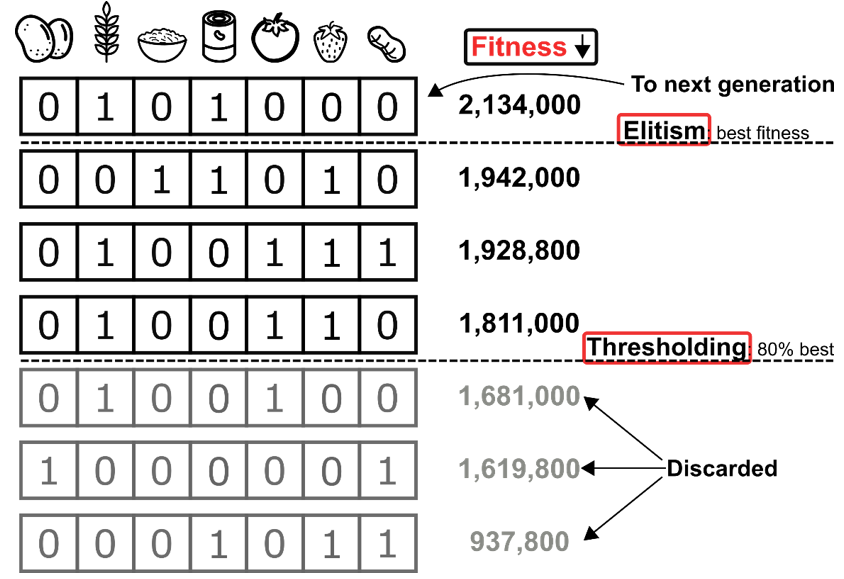
1/n * [(n-2)/n]k-1

This is an excerpt from Manning's book Grokking Artificial Intelligence Algorithms.
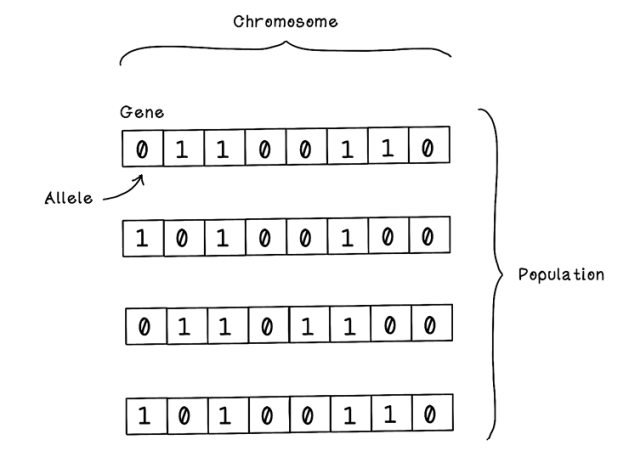
With respect to evolutionary algorithms, an individual candidate solution is called a chromosome. A chromosome is made up of genes. The gene is the logical type for the unit, and the allele is the actual value stored in that unit. A genotype is a representation of a solution, and a phenotype is a unique solution itself. Each chromosome always has the same number of genes. A collection of chromosomes forms a population (figure 4.11).
Figure 4.11 Terminology of the data structures representing a population of solutions
In the Knapsack Problem, several items can be placed in the knapsack. A simple way to describe a possible solution that contains some items but not others is binary encoding (figure 4.12). Binary encoding represents excluded items with 0s and included items with 1s. If the value at gene index 3 is 1, for example, that item is marked to be included. The complete binary string is always the same size: the number of items available for selection. Several alternative encoding schemes exist, however, and are described in chapter 5.
Population initialization—Although the individuals in a population are initialized randomly, ensuring that the solutions are valid is important for optimizing the computation of the genetic algorithm and initializing individuals with the right constraints.
Number of offspring—The number of offspring created in each generation can be configured. Given that after reproduction, part of the population is killed off to ensure that the population size is fixed, more offspring means more diversity, but there is a risk that good solutions will be killed off to accommodate those offspring. If the population is dynamic, the population size may change after every generation, but this approach requires more parameters to configure and control.
Number of offspring—The number of offspring created in each generation can be configured. Given that after reproduction, part of the population is killed off to ensure that the population size is fixed, more offspring means more diversity, but there is a risk that good solutions will be killed off to accommodate those offspring. If the population is dynamic, the population size may change after every generation, but this approach requires more parameters to configure and control.
Parent selection method—The selection method used to choose parents can be configured. The selection method must be based on the problem and the desired explorability versus exploitability.