concept sake in category algorithms

This is an excerpt from Manning's book Algorithms and Data Structures in Action.
Describing them is pretty much a standard process: algorithms are described in terms of the input they take, and the output they provide. Their details can be illustrated with pseudo-code (ignoring implementation details of programming languages), or actual code.
Figure 5.2 An example of an application of disjoint-set.
(A) In this scenario, an e-commerce website is trying to understand what products sell well together, in order to provide better recommendations to its customers.
(B) Initially, each item on sale is in a different category (this would also work if we started from already pre-defined categories, like SSD disks or blenders, and grouped categories of objects selling together. But for the sake of simplicity, bear with me, and imagine there is only one product of each category on sale).
(C) Items frequently bought together, like laptops and external disks, or tennis rackets and tennis balls, are grouped together.
(D) After a while, things tend to stabilize and steady groups are formed. Now next time a customer adds a football to her cart, we can suggest a pair of skis as a follow up purchase.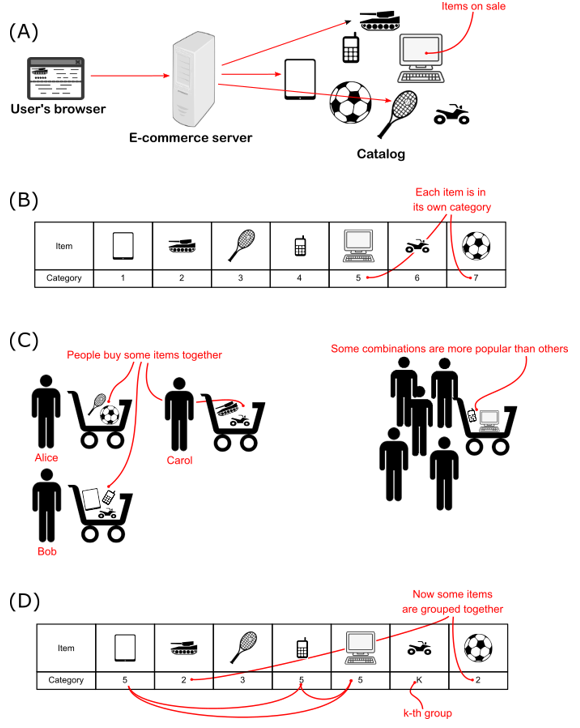
In real-world examples, customers have hundreds of features that are considered for marketing segmentation; here, for the sake of visualization and to make explanations easier, we will use a simplified example, with just two features: annual income and average monthly expenses on our e-commerce site. We will pick this example up again later in the chapter, but first, we will give you some more context and the tools to perform clustering analysis.