concept text in category algorithms
appears as: text, text, texts

This is an excerpt from Manning's book Algorithms and Data Structures in Action.
The largest it is the branching factor D, the fewer calls are made to _highest_priority_child: this becomes apparent if, instead of plotting the running time per-call for _highest_priority_child, we use the total cumulative time (the sum of all calls to each method), as shown in figure 2.24.B: there we can see again how this composite function, f(D) = D*logD(n), has a minimum at D==9.
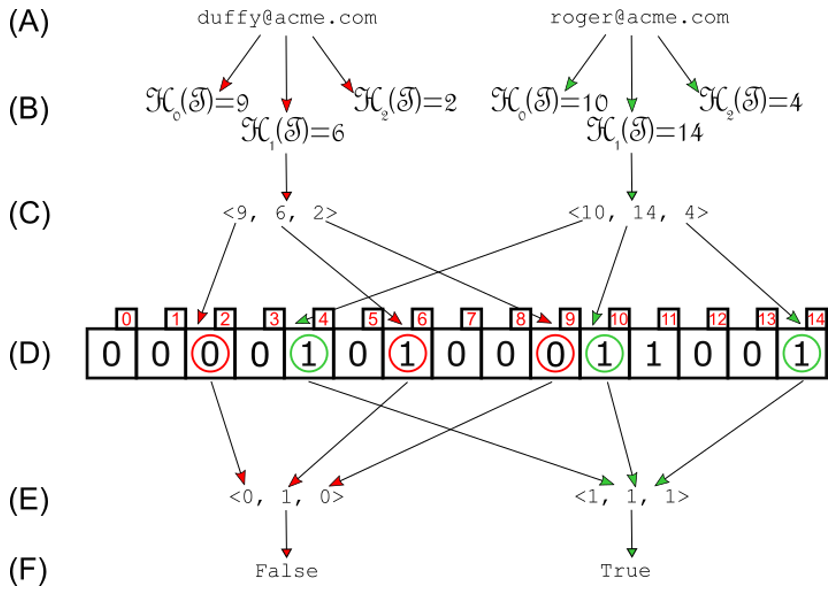
Figure 4.4 Checking if an entry is in a Bloom filter, step by step.
(A) We start with the email we would like to check, “duffy@acme.com”.
(B) The key (our email) is processed through our set of hash functions: in our example we assume k=3, so we’ll have 3 different hash functions, H0, H1 and H2.
(C) Each hash function produces an index for our binary array: in this case the three indices might be, for instance, <9, 6, 2>.
(D) We access the elements of the binary array at those indices.
(E) The first element, at index 2, is 0. The other bits are 0 and 1 respectively.
(F) Since not all the bits we checked were equals to 1, it means that “duffy@acme.com”.is not stored in the Bloom filter, and we will return false.
The same workflow is followed for “roger@acme.com”, on the right: because all three bits checked are set to 1, we return true: this means that “roger@acme.com” might have been stored in the Bloom filter, with a certain degree of confidence.