concept Java in category android

This is an excerpt from Manning's book RxJava for Android Developers.
Java is a common language that almost everyone has come across at some point in their developer life. Java is strongly and explicitly typed, which makes following the data-type conversions easier.
Immutability of data might seem like a harsh limitation, and indeed it’s sometimes a little inconvenient in a language such as Java. But, you no longer have to guess when a data value might have changed without your noticing—it never will. Every time a change occurs, you’ll receive a completely new instance of data.
This is an excerpt from Manning's book Android in Action, Third Edition.
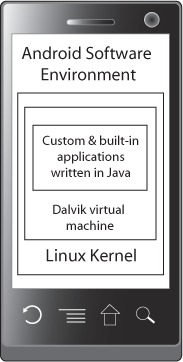
Android is a software environment built for mobile devices. It’s not a hardware platform. Android includes a Linux kernel-based OS, a rich UI, end-user applications, code libraries, application frameworks, multimedia support, and much more. And, yes, even telephone functionality is included! Whereas components of the underlying OS are written in C or C++, user applications are built for Android in Java. Even the built-in applications are written in Java. With the exception of some Linux exploratory exercises in chapter 13 and the Native Developer Kit (NDK) in chapter 19, all the code examples in this book are written in Java, using the Android software development kit (SDK).
Resources are treated specially in Android because they’re typically compiled into an efficient binary type, with the noted exceptions of items that are already binary and the raw type, which isn’t compiled. Animations, layouts and views, string and color values, and arrays can all be defined in an XML format on the platform. These XML resources are then processed by the aapt tool, which you saw in chapter 2, and compiled. After resources have been compiled, they’re accessible in Java through the automatically generated R class.
This is an excerpt from Manning's book Android in Practice.
For that Matter, Do I Have to Use Java?
For those out there who don’t prefer Java, Android hasn’t forgotten you entirely, and neither have we. We’ll touch on using alternative languages such as Scala in an appendix. And, we’ll also look at building web applications (using JavaScript and CSS, for example) for Android too. These are broad topics so we can’t cover them in depth, but we want to at least introduce them and make sure you know there are options. That said, Java is the main development language of Android, and it’ll be the main language we use throughout this book.