concept OpenGL in category android
This is an excerpt from Manning's book Android in Action, Third Edition.
If you’ve ever worked with graphics in Java, you’ll likely find the Graphics API and how graphics work in Android familiar. If you’ve worked with OpenGL, you’ll find Android’s implementation of OpenGL ES reasonably straightforward. You must remember, though, that cell phones, tablets, and other mobile devices don’t have the graphical processing power of a desktop. Regardless of your experience, you’ll find the Android Graphics API both powerful and rich, allowing you to accomplish even some of the most complex graphical tasks.
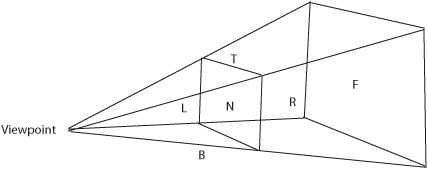
One important part of maintaining the illusion of depth is providing perspective. In OpenGL, a typical perspective is represented by a viewpoint with near and far clipping planes and top, bottom, left, and right planes, where objects that are closer to the far plane appear smaller, as in figure 9.7.
One of the most interesting features of the Android platform is its support of OpenGL for Embedded Systems (OpenGL ES). OpenGL ES is the embedded systems version of the popular OpenGL standard, which defines a cross-platform and cross-language API for computer graphics. The OpenGL ES API doesn’t support the full OpenGL API, and much of the OpenGL API has been stripped out to allow OpenGL ES to run on a variety of mobile phones, PDAs, video game consoles, and other embedded systems. OpenGL ES was originally developed by the Khronos Group, an industry consortium. You can find the most current version of the standard at www.khronos.org/opengles/.
This is an excerpt from Manning's book Android in Practice.
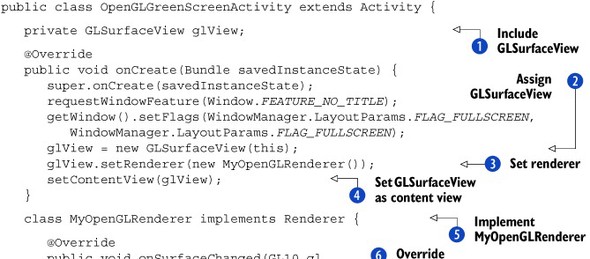
OpenGL is the Open Graphics Library, an open cross-language, cross-platform accelerated 2D/3D graphics platform. The ES indicates that the flavor included with Android is the embedded systems version. This means it’s optimized for use in phones, tablets, set-top boxes, consoles, and the like. It’s a subset of the full desktop version, but it’s still capable and powerful.
Learning More about OpenGL
We aren’t going to get into the full ins and outs of OpenGL programming. That’s a book in and of itself. If you’re looking for more information on OpenGL development, the Neon Helium lessons at http://nehe.gamedev.net are an excellent resource. In the next few sections, we’ll cover some of the same ground as the early lessons, but our purpose isn’t to cover every facet of OpenGL programming, but rather to get you acquainted with using OpenGL on Android.