concept dependency in category ant

This is an excerpt from Manning's book Ant in Action.
Figure 1.1. Conceptual view of a build file. The project encompasses a collection of targets. Inside each target are task declarations, which are statements of the actions Ant must take to build that target. Targets can state their dependencies on other targets, producing a graph of dependencies. When executing a target, all its dependents must execute first.

ivy-resolve:
[ivy:resolve] :: resolving dependencies ::
  [ org.antbook | diary-core |working@Zermatt ]
[ivy:resolve]   confs: [compile, test, master, runtime, default]
[ivy:resolve]   found [ log4j | log4j | 1.2.13 ] in maven2
[ivy:resolve]   found [ junit | junit | 3.8.2 ] in maven2
[ivy:resolve] :: resolution report ::
-------------------------------------------------------------------
|                |            modules            ||   artifacts   |
|     conf       | number| search|dwnlded|evicted|| number|dwnlded|
-------------------------------------------------------------------
|    compile     |   1   |   0   |   0   |   0   ||   1   |   0   |
|     test       |   2   |   0   |   0   |   0   ||   2   |   0   |
|    master      |   0   |   0   |   0   |   0   ||   0   |   0   |
|    runtime     |   1   |   0   |   0   |   0   ||   1   |   0   |
|    default     |   1   |   0   |   0   |   0   ||   1   |   0   |
-------------------------------------------------------------------

BUILD SUCCESSFUL
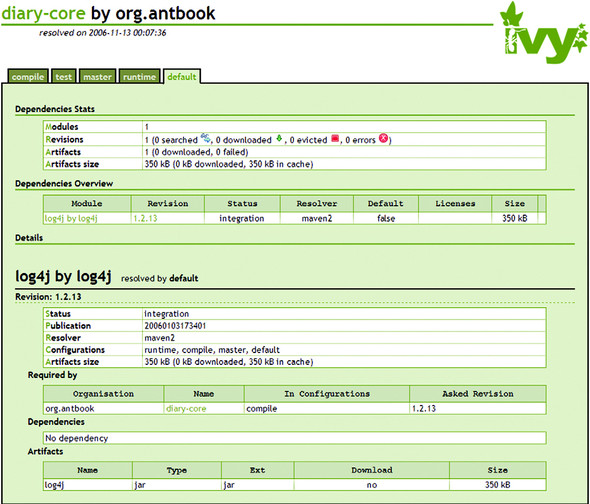
Ordering the builds by hand works if the dependencies are simple and known by the author of the master build file, but doing so doesn’t scale. Once you have more than a few projects, projects with different team members maintaining the build.xml and ivy.xml files, soon you have dependencies where you don’t expect. If the list of build files to delegate to isn’t kept synchronized, projects start building with outdated artifacts and developers start wondering why changes don’t propagate, or worse: you ship old code.
The main concept behind Ivy is that Ivy files describe the dependencies of a Java library or application, something they term a module. Every module or child project in a big application has its own ivy.xml file. This file lists what configurations the module has, such as compile, test, standalone, or embedded. Each configuration lists the artifacts it depends on and the artifacts it generates. The dependencies can be used to set up the classpath for part of the project or to compile files for redistribution. The generated artifacts can be published to a repository, including the local file system. Other projects can declare a dependency on the published artifacts, listing the name of the project, the module, and the version required. They can also declare the configurations of a module on which they want to depend. A module not only exports its own artifacts, but it can also export those artifacts on which it depends. “Downstream” modules can get all of these dependencies too, if they want.