concept Airflow deployment in category apache airflow
This is an excerpt from Manning's book Data Pipelines with Apache Airflow.
Finally, several chapters towards the end of the book focus on topics surrounding the deployment of Airflow, including deployment patterns, monitoring, security, cloud architectures, etc. We expect these chapters to be of special interest for people interested in rolling out and managing Airflow deployments, such as system administrators and DevOps engineers.
In this chapter we’ll dive into how Airflow can be used on several major cloud platforms (Amazon AWS, Microsoft Azure and Google Cloud Platform). First, we’ll do a short recap of the different parts of an Airflow deployment to get an overview of the involved components. Next, for each of the three clouds (Amazon AWS, Microsoft Azure and Google Cloud Platform), we’ll start designing several deployment strategies for each cloud by mapping the different Airflow components to appropriate cloud services. Afterwards, we’ll discuss and demonstrate how cloud-specific operators can be used in Airflow to leverage other cloud services from within DAGs. Finally, we’ll close off with a short overview of some managed cloud services, which provide an easier approach for rolling out Airflow deployments without having to manage all the underlying cloud services ourselves.
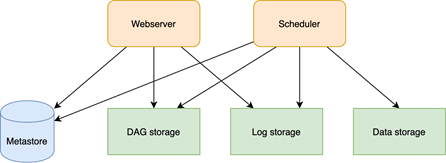
To keep things simple, we’ll start with an Airflow deployment based on the LocalExecutor. In this type of setup, the Airflow workers are running on the same machine as the scheduler, meaning we only need to set up two compute resources for Airflow: one for the webserver and one for the scheduler (Figure 13.1).
Figure 13.1 - Overview of the different compute and storage components involved in an Airflow deployment based on the LocalExecutor.