concept HTTPS in category apache airflow
This is an excerpt from Manning's book Data Pipelines with Apache Airflow.
We can work with the Airflow webserver via a browser, which communicates with Airflow via the HTTP protocol. To communicate with the Airflow webserver in a secure manner, we must communicate over HTTPS (HTTP Secure). Before securing traffic to the webserver, let’s first understand the difference between HTTP and HTTPS. If you already know this, you can skip to Section 14.4.2.
So, what is different with HTTPS? To understand how HTTPS works and what the private key and certificate are for, let’s first establish how HTTP works:
When your browser and a webserver communicate over HTTPS, the initial handshake involves more steps to verify the validity of the remote side:
Figure 14.18 At the start of an HTTPS session, the browser and webserver agree on a mutual session key to encrypt and decrypt traffic between the two.
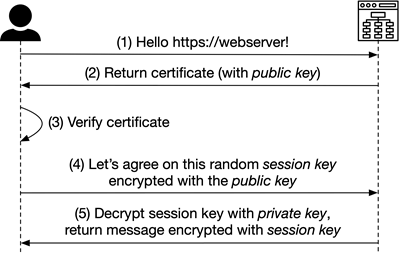
The encryption used in HTTPS is TLS (Transport Layer Security), which uses both asymmetric encryption and symmetric encryption. Whereas symmetric encryption applies one single key for both encryption and decryption, asymmetric encryption consists of two keys: a public and a private key. The “magic” of asymmetric encryption is that data encrypted with the public key can only be decrypted with the private key (which only the webserver knows), and data encrypted with the private key can only be decrypted with the public key.