concept main product in category api

This is an excerpt from Manning's book Irresistible APIs: Designing web APIs that developers will love.
When thinking about business value, think of the elevator pitch so commonly targeted by new startups. If you get in the elevator with the CEO of your company and he asks why you have an API, you need to be able to succinctly answer the question in a way that convinces him that it’s a valuable product. “Developer engagement” or “API use” is not a great goal. You need a tangible goal related to the larger business such as “Increase user engagement,” “Establish industry leadership,” “Move activity off the main product to the API,” or “Engage and retain partners.” Monetization is a nice aim, but unless your API is your main product, you need to see it as a supporting product, enhancing the value of your product.
When you’re setting up an API, the vision for the entire platform is quite important, from determining the business value through structure and design decisions. I’m going to step back for a moment from the practical description of APIs in order to talk about an overarching model that is generally superior to the old model of creating APIs in parallel with the main product.
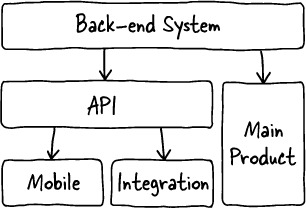
Previous models for product lines with multiple different interfaces, such as mobile or integration, were created so that each of the integration points available for the different client use cases were built independently. This generally led to unfortunate consequences—APIs that were creating code already written for the main product, APIs that were perennially behind in features and functions, and a great deal of technical debt because each change to the system needed to be pulled into each type of client.
Figure 3.1. This is an API that was set up as many of the first platforms were created: the main product interacts directly with the back-end system, leaving the APIs as second-class citizens in the product hierarchy. Any new changes or features in the main product have to be duplicated in the API, resulting in feature inconsistency and incompatible resource representation.