concept detail in category asp.net

This is an excerpt from Manning's book ASP.NET Core in Action, Second Edition.
The request is forwarded from the reverse proxy to your ASP.NET Core application. Every ASP.NET Core application has a built-in web server, Kestrel by default, which is responsible for receiving raw requests and constructing an internal representation of the data, an
HttpContextobject, which can be used by the rest of the application.
Having run your application, the next step is to understand what’s going on! We’ll take a journey through all the major parts of an ASP.NET Core application, looking at how to configure the web server, the middleware pipeline, and HTML generation, among other things. We won’t go into detail at this stage, but you’ll get a feel for how they all work together to create a complete application.
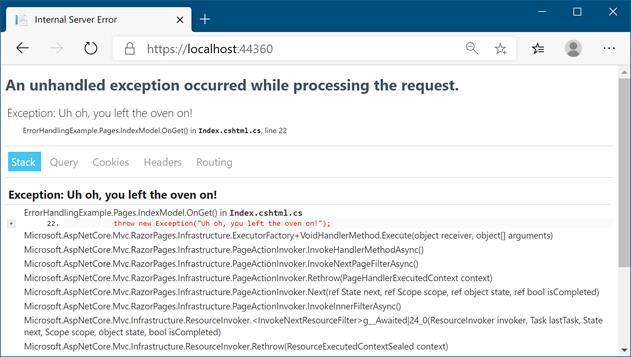
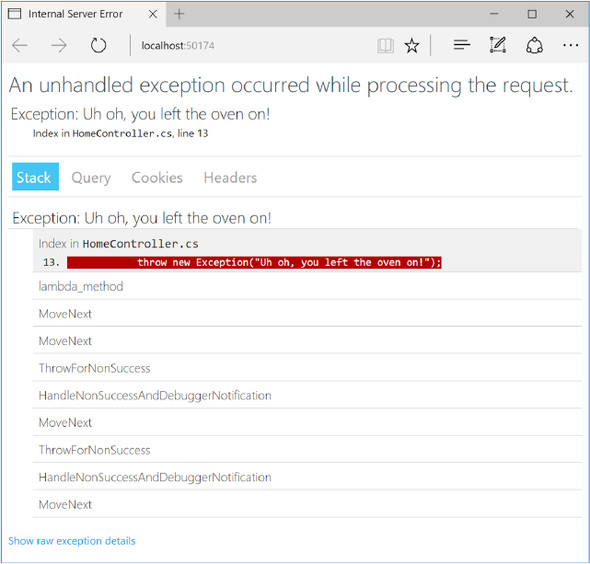
Figure 2.11 The developer exception page contains many different sources of information to help you diagnose a problem, including the exception stack trace and details about the request that generated the exception.

This is an excerpt from Manning's book ASP.NET Core in Action.
From this representation, your application should have all the details it needs to create an appropriate response to the request. It can use the details stored in HttpContext to generate an appropriate response, which may be to generate some HTML, to return an “access denied” message, or to send an email, all depending on your application’s requirements.
Having run your application, the next step is to understand what’s going on! We’ll take a journey through all the major parts of an ASP.NET Core application, looking at how to configure the web server, the middleware pipeline, and HTML generation, among other things. We won’t go into detail at this stage, but you’ll get a feel for how they all work together to create a complete application.
I’ll cover Razor templates, including layouts, in detail in chapter 7.
Listing 12.3. Defining the application DbContext
public class AppDbContext : DbContext { public AppDbContext(DbContextOptions<AppDbContext> options) #1 : base(options) { } #1 public DbSet<Recipe> Recipes { get; set; } #2 } #1 The constructor options object, containing details such as the connection string #2 You’ll use the Recipes property to query the database. !@%STYLE%@! {"css":"{\"css\": \"font-weight: bold;\"}","target":"[[{\"line\":2,\"ch\":66},{\"line\":2,\"ch\":68}],[{\"line\":3,\"ch\":66},{\"line\":3,\"ch\":68}],[{\"line\":8,\"ch\":0},{\"line\":8,\"ch\":2}],[{\"line\":2,\"ch\":66},{\"line\":2,\"ch\":68}],[{\"line\":3,\"ch\":66},{\"line\":3,\"ch\":68}],[{\"line\":8,\"ch\":0},{\"line\":8,\"ch\":2}],[{\"line\":5,\"ch\":66},{\"line\":5,\"ch\":68}],[{\"line\":9,\"ch\":0},{\"line\":9,\"ch\":2}]]"} !@%STYLE%@!

This is an excerpt from Manning's book ASP.NET 4.0 in Practice.
Let’s imagine that we want to build an application to manage a book library. One action associated with this application is “list the books”, another is “give me details about a particular book”, and so on. To display the results for these actions, we need a specific web page that extracts data from our storage system. The storage system is probably a database synchronized with our backend.
Security is about best practices used the right way and about taking care of details in your application. Security is pervasive and affects every aspect of your software production cycle, from initial planning to architecture, development, and deployment. This book won’t cover hardware or operating-system security, but you have to remember that these are important elements in your security strategy, too.