concept ioption in category asp.net

This is an excerpt from Manning's book ASP.NET Core in Action.
To help facilitate the binding of configuration values to your custom POCO options classes, ASP.NET Core introduces the IOptions<T> interface. This is a simple interface with a single property, Value, which contains your configured POCO options class at runtime. Options classes are set up in the ConfigureServices section of Startup, as shown here.
Chapter 11 described the configuration provider system used by ASP.NET Core, but in section 19.2, we look at more complex scenarios. In particular, I’ll show you how to handle the situation where a configuration provider itself needs some configuration values. For example, a configuration provider that reads values from a database might need a connection string. You’ll also see how to use DI when configuring strongly typed IOptions objects, something not possible using the methods you’ve seen so far.
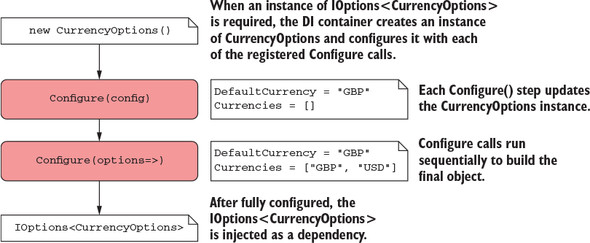
This sets the properties of the CurrencyOptions object, based on the values in the "Currencies" section of your IConfiguration object. Sometimes, you might want to customize the configuration of your IOptions<T> objects, or you might not want to bind them to configuration at all. The IOptions pattern only requires you to configure a strongly typed object before it’s injected into a dependent service, it doesn’t mandate that you have to bind it to an IConfiguration section.