concept web application in category asp.net

This is an excerpt from Manning's book ASP.NET Core in Action, Second Edition.
Just as you may have used desktop or mobile development frameworks for building native applications, ASP.NET Core makes writing web applications faster, easier, and more secure than trying to build everything from scratch. It contains libraries for common things like
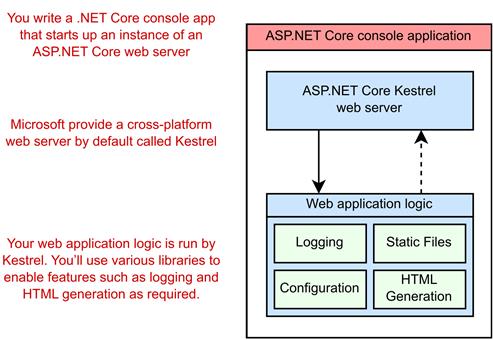
With .NET Core alone, it’s possible to build console applications that run cross-platform. Microsoft created ASP.NET Core to be an additional layer on top of console applications, such that converting to a web application involves adding and composing libraries, as shown in figure 1.3.
Figure 1.2 The relationship between ASP.NET Core, ASP.NET, .NET Core, and .NET Framework. ASP.NET Core runs on .NET Core, so it can run cross-platform. Conversely, ASP.NET runs on .NET Framework only, so is tied to the Windows OS.
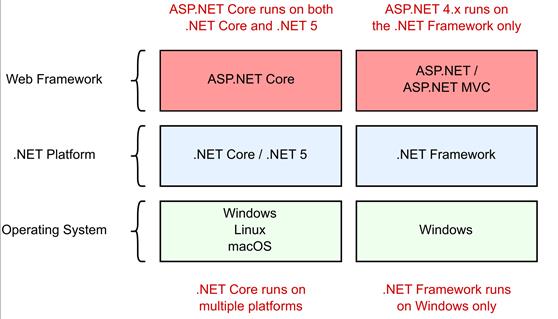
Figure 1.3 The ASP.NET Core application model. The .NET Core platform provides a base console application model for running command-line apps. Adding a web server library converts this into an ASP.NET Core web app. Additional features, such as configuration and logging, are added by way of additional libraries.

This is an excerpt from Manning's book ASP.NET Core in Action.
The first version of ASP.NET was released in 2002 as part of .NET Framework 1.0, in response to the then conventional scripting environments of classic ASP and PHP. ASP.NET Web Forms allowed developers to rapidly create web applications using a graphical designer and a simple event model that mirrored desktop application-building techniques.
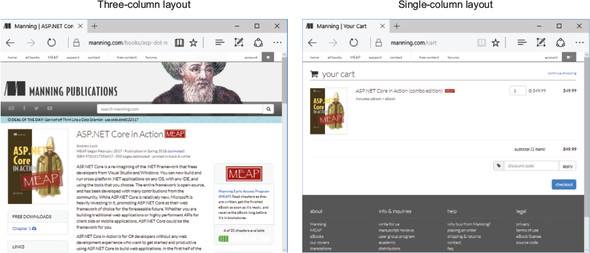
Figure 7.14. The https://manning.com website uses different layouts for different parts of the web application. The product pages use a three-column layout, but the cart page uses a single-column layout.

This is an excerpt from Manning's book ASP.NET 4.0 in Practice.
Input validation is a key factor in today applications. Both the client-side and server-side validation offered by validator controls in Web Forms is a killer feature for web applications, and you get it by default. It’s just one of the free services the ASP.NET infrastructure lets you use to enhance your UI.
This state of affairs recently pushed Microsoft in the direction of creating another platform, parallel to Web Forms. This platform proposes a different model to develop web applications, but still shares the same ASP.NET infrastructure. The platform is ASP.NET MVC.