concept microservice in category aws

This is an excerpt from Manning's book Serverless Architectures on AWS, Second Edition.
The modern incarnation of the service-oriented approach is often referred to as microservices architectures. Modern application architectures are composed or services, communicating through events and APIs, with business logic inserted as appropriate. You should think of microservices as small, standalone, fully independent services built around a particular business purpose or capability. Ideally, microservices should be easy to replace, with each service written in an appropriate framework and language. The mere fact that microservices can be written in different general-purpose or domain-specific languages (DSL) is a drawing card for many developers. Benefits can be gained from using the right language or a specialized set of libraries for the job. Each microservice can maintain state and store data. And if microservices are correctly decoupled, development teams can work and deploy microservices independently of one another. This approach of building and deploying applications as a collection of loosely coupled services is considered the default approach to development in the cloud today (the “cloud native” approach, if you will).
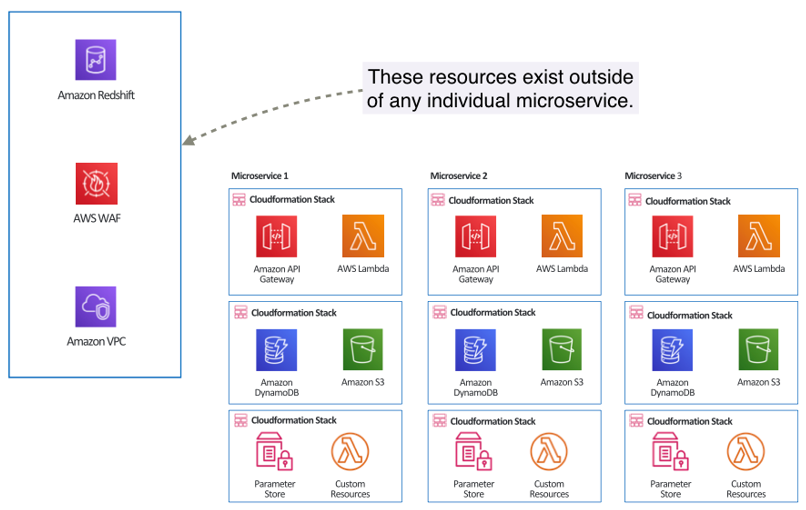
Figure 5.5 There are global dependencies outside of each individual microservice. Not everything has to exist within a microservice.

This is an excerpt from Manning's book AWS Lambda in Action: Event-driven serverless applications.
For a broader description of what microservices are and how to use them for your particular use case, I suggest you start with Martin Fowler’s resource guide at http://martinfowler.com/microservices/.
If you recall how to design an event-driven application, and how AWS Lambda works by decomposing your application into small functions that can interact only via events, you’ll see that the approach described in this book puts you on the right path to implement microservices—but you still have great responsibility in the implementation.