concept number in category aws

This is an excerpt from Manning's book Serverless Architectures on AWS, Second Edition.
Serverless architecture allows developers to focus on software design and code rather than infrastructure. Scalability and high availability are easier to achieve, and the pricing is often fairer because you pay only for what you use. More importantly, you have a potential to reduce some of the complexity of the system by minimizing the number of layers and amount of code needed. Adopting a serverless approach to application development comes with significant agility, elasticity, and cost efficiency gains. However, it is easy to fall into the trap of trying to adopt a serverless approach for *all* applications. We recommend keeping a few principles in mind as you start your serverless journey.
The second thing to consider is that the throughput of the DynamoDB Stream is constrained by the number of shards in the stream. The number of shards is in turn determined by the number of partitions in the DynamoDB table. However, there’s no way for you to directly control the number of partitions, it’s entirely managed by DynamoDB based on the number of items in the table and its read and write throughputs.
Instead of executing the scheduled task immediately after the Waitstate, get a count of the number of tasks that need to run. From here, use aMapstate to dynamically generate parallel branches to run these tasks in parallel. See figure 7.16 for how this alternative design might look.Figure 7.16 An alternative design for the state machine that can run tasks in batches in parallel.
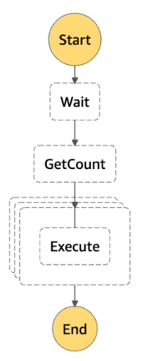
Making these changes would not affect the precision by too much but it would reduce the number of state machine executions and Lambda invocations required. Essentially, we need one state machine execution for every minute when we need to execute some scheduled tasks. There is a total of 525600 minutes in a 365 days calendar year, so this also removes the need to increase the limit on the number of open executions (again, the default limit is 1,000,000).

This is an excerpt from Manning's book Amazon Web Services in Action, Second Edition.
Based on traffic—Traffic is measured in gigabytes or in number of requests, for example.
How many people will attend? You received several confirmations, but some guests will cancel at short notice or show up without letting you know in advance. So the number of guests is vague.
Public cloud providers like AWS can offer the needed capacity with a short waiting time. AWS serves millions of customers, and at that scale it isn’t a problem to provide you with 100 additional virtual machines within minutes if you need them suddenly. This allows you to address another problem: typical traffic patterns, as shown in figure 17.1. Think about the load on your infrastructure during the day versus at night, on a weekday versus the weekend, or before Christmas versus the rest of year. Wouldn’t it be nice if you could add capacity when traffic grows and remove capacity when traffic shrinks? In this chapter, you’ll learn how to scale the number of virtual machines based on current load.
Scaling the number of virtual machines is possible with auto-scaling groups (ASG) and scaling policies on AWS. Auto-scaling is part of the EC2 service and helps you to scale the number of EC2 instances you need to fulfill the current load of your system. We introduced auto-scaling groups in chapter 14 to ensure that a single virtual machine was running even if an outage of an entire data center occurred. In this chapter, you’ll learn how to use a dynamic EC2 instance pool: