concept set in category azure

This is an excerpt from Manning's book Azure Storage, Streaming, and Batch Analytics: A guide for data engineers.
A distributed query system partitions queries into multiple executable units and executes them over multiple files. In Hadoop analytics systems, the MapReduce algorithm handles distributing a query over multiple nodes as a two step process. Each Hadoop cluster node maps requested data to a single file, and the query returns results from that file. The results from all the files are combined, and the resulting set of data is reduced to a set fulfilling the query. Multiple cluster nodes divide the Map and Reduce tasks between them. This enables efficient querying of large scale collections. New queries can be set for scheduled updates or submitted for a single result. Multiple query jobs can run simultaneously, each using multiple nodes.
Azure Cognitive Services bundles a set of ML algorithms into APIs. Microsoft developed these algorithms using millions of iterations of content data analysis, including images, video, audio, and text data sources. The resulting algorithms are bundled into assemblies for developer use. These assemblies accept unstructured data content and return structured data about the objects in the content. The inputs include text-, image-, audio-, and video-analysis algorithms. To use the algorithms, you create Cognitive Service endpoints as resources in your Azure account. The API service endpoints are available through REST HTTP calls and through a .NET SDK library integration. Figure 9.2 shows how a system for analyzing data with Cognitive services could be structured.
Figure 9.2. .NET integration with Cognitive services
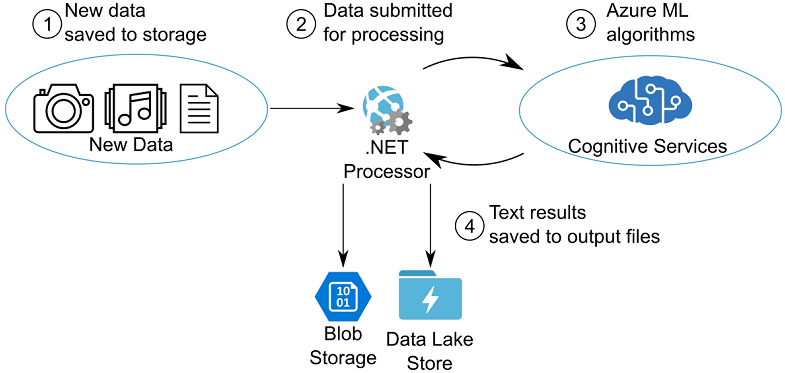
To fulfill the image processing request, you could build an application to use these APIs, and send the data to it. This approach makes sense if you need immediate analysis of images. But the ADLA support team has made using Cognitive Services much easier than this. They have created a set of assemblies for using the ML text- and image-algorithms in U-SQL scripts. Using an ADLA job allows parallel processing of images without extra code complexity, and you can immediately process the output using logic in the job. The ADLA Cognitive assemblies let you analyze text and image content within ADLA jobs. You need to load and register the U-SQL Cognitive assemblies to use them in a job.