concept storage in category azure
This is an excerpt from Manning's book Azure Storage, Streaming, and Batch Analytics: A guide for data engineers.
Data engineers build storage and processing systems that can grow to handle these high volume, high velocity data flows. They plan for variation and volume. They manage systems that provide business value by answering questions with data.
The next level of abstraction provides a Platform as a Service (PaaS). PaaS provides server application hosting such as web servers, databases, and storage. The provider manages the hardware and operating system running in their data center, and manages server applications running on the operating system. The end user configures and uses the applications. PaaS resources require developer support to create code to run on the server applications.

This is an excerpt from Manning's book Learn Azure in a Month of Lunches, Second Edition.
This second edition of the book introduces some of these core concepts in Azure and teaches you the skills you need to make informed decisions. Coming into this book, you should have some experience with VMs and know the basics of networking and storage. You should also be able to create a basic website, as well as understand what an SSL certificate and a database are. After we cover the core processes, we’ll take a quick look at new and upcoming technologies. You want to stay ahead of where your job may take you, so you’ll learn about containers, the Internet of Things, machine learning, artificial intelligence, and serverless computing. Both self-described developers and IT pros should find some neat new areas to learn about!
We can be certain of one thing in the IT world: when things go wrong, storage and networking are inevitably to blame. I say this as someone who wore the hat of a SAN admin in one of my past lives! I was best friends with the networking team. I’m mostly joking (about being best friends), but it doesn’t matter how well an application is designed and written: the foundational infrastructure pieces must be in place to support it. Bear with me in the next couple of chapters as I explore Azure Storage and Azure Networking. You may tempted to brush over these services to get to the cool stuff in the later chapters, but there’s a lot of value in spending some time exploring and learning these core services. It won’t make your food taste any better, but it may help your customers as they order their yummy pizzas for delivery!
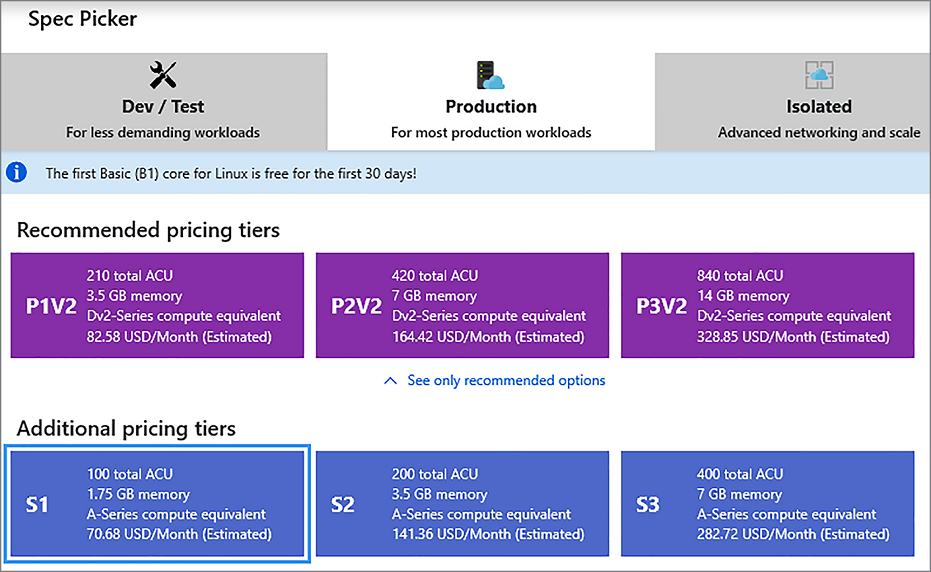
Figure 9.3 To manually scale a web app vertically, you change the pricing tier (size) of the underlying app service plan. The app service plan defines the amount of resources assigned to your web app. If your application requires a different amount of storage, number of CPUs, or deployment slots, you can change to a different tier to right-size the assigned resources to the application demand.