concept conversation in category BDD

This is an excerpt from Manning's book BDD in Action Second Edition.
BDD practitioners use conversations around concrete examples of system behavior to help understand how features will provide value to the business. BDD encourages business analysts, software developers, and testers to collaborate more closely by enabling them to express requirements in a more testable way, in a form that both the development team and business stakeholders can easily understand. BDD tools can help turn these requirements into automated tests that help guide the developer, verify the feature, and document what the application does.
Teams that practice BDD use conversations about concrete examples and counter-examples of business rules to come up with these acceptance criteria. In terms of the BDD cycle we saw in Chapter 1, these conversations are common during the Illustrate phase, the second part of the requirements discovery process that starts with the Speculate activities we saw in the previous chapters.
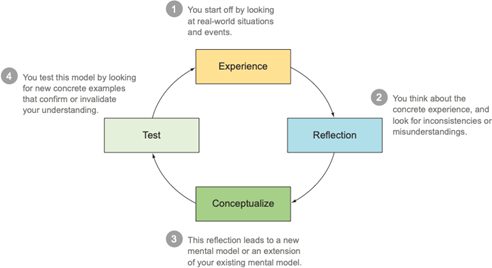
BDD uses a very similar approach (see figure 5.3), where examples and conversation with users, stakeholders, and domain experts drive the learning process. You discuss concrete examples of how an application should behave #1 and reflect on these examples #2 to build up a shared understanding of the requirements #3. Then you look for additional examples to confirm or extend your understanding #4.
Figure 5.3 David Kolb’s Experimental Learning theories apply well to BDD.
Let’s see how this works in practice. The story card and the initial acceptance criteria jotted down on the back (or in some dedicated field if you are using software to track your backlog) make a great place to start a conversation that will discover these examples. To see what such a conversation might look like, let’s revisit the “secure password” user story we discussed in section 4.1.3. Bianca (the Business Analyst), Terri (the Tester) and David (the Developer), who work on the Frequent Flyer project, are discussing the requirements. The story goes like this:

This is an excerpt from Manning's book BDD in Action: Behavior-Driven Development for the whole software lifecycle.
Agile practitioners are fond of emphasizing that a user story is not actually a requirement, but more a promise to have a conversation with the stakeholders about a requirement. Stories are a little like entries in a to-do list, giving you a general picture of what needs to be done, and reminding you to go ask about the details when you come to implement the story.
Examples are at the heart of BDD. In conversations with users and stakeholders, BDD practitioners use concrete examples to develop their understanding of features and user stories of all sizes, but also to flush out and clarify areas of uncertainty (see figure 4.13). These examples, expressed in language that business can understand, illustrate how the software should behave in very precise and unambiguous terms.
BDD uses a very similar approach (see figure 4.14), where examples and conversation with users, stakeholders, and domain experts drive the learning process. You discuss concrete examples of how an application should behave
and reflect on these examples
to build up a shared understanding of the requirements
. Then you look for additional examples to confirm or extend your understanding
.
Let’s see how this works in practice. The story card and the initial acceptance criteria jotted down on the back (figures 4.9 and 4.10) make a great place to start a conversation that will discover these examples. To see what such a conversation might look like, let’s revisit the “secure password” user story we discussed in section 4.1.3.