concept living documentation in category BDD

This is an excerpt from Manning's book BDD in Action Second Edition.
Deliver living documentation
The reports produced by executable specifications aren’t simply technical reports for developers but effectively become a form of product documentation for the whole team, expressed in a vocabulary familiar to users (see figure 1.11). This documentation is always up to date and requires little or no manual maintenance. It’s automatically produced from the latest version of the application. Each application feature is described in readable terms and is illustrated by a few key examples. For web applications, this sort of living documentation often also includes screenshots of the application for each feature.
Figure 1.11 High-level and low-level executable specifications generate different sorts of living documentation for the system.
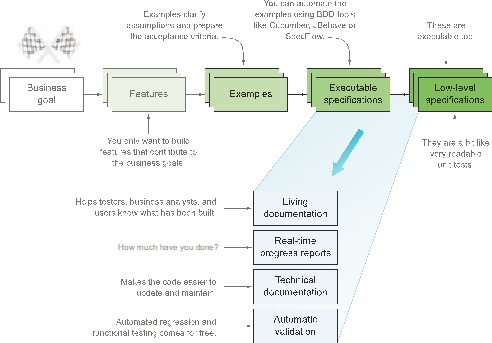
Figure 1.11 High-level and low-level executable specifications generate different sorts of living documentation for the system.
But living documentation is more than just test reporting. It should also report on the state of all of your specified requirements, even the ones that don’t have any tests yet. This gives a much more complete picture of your project and your product. For example, Serenity BDD reports both on features that have been built and tested, but also features that have only been planned and defined in the form of unimplemented feature files (you can see an example in figure 2.7).

This is an excerpt from Manning's book BDD in Action: Behavior-Driven Development for the whole software lifecycle.
The reports produced by executable specifications aren’t simply technical reports for developers but effectively become a form of product documentation for the whole team, expressed in a vocabulary familiar to users (see figure 1.11). This documentation is always up to date and requires little or no manual maintenance. It’s automatically produced from the latest version of the application. Each application feature is described in readable terms and is illustrated by a few key examples. For web applications, this sort of living documentation often also includes screenshots of the application for each feature.
In this way, BDD reporting completes the circle that started with the initial conversations with business stakeholders. The stakeholders, business analysts, testers, and anyone else that participated in the conversations leading up to the scenarios and executable specifications see the conversations they had, and the examples they discussed appear as part of the generated reports. This feedback loop is a great way to get buy-in from business stakeholders, who are often much more keen to contribute actively when they see the results of their contributions verbatim in the living documentation. In addition, because the reports are generated automatically from the automated acceptance criteria, it’s a fast and efficient way of providing feedback once it’s set up (see figure 11.2).
Figure 11.2. Living documentation is generated automatically from the executable specifications, which simplifies reporting and accelerates the feedback cycle.
![]()
Testers also use the living documentation to complement their own testing activities, to understand how features have been implemented, and to get a better idea of the areas in which they should focus their exploratory testing.
The benefits of living documentation shouldn’t end when a project is delivered. When organized appropriately, living documentation is also a great way to bring new team members up to speed not only with what the application is supposed to do, but also how it does so. For organizations that hand over projects to a different team once they go into production, the benefits of this alone can be worth the time invested in setting up the living documentation reporting.
Organizing living documentation to reflect the requirements hierarchy of the project Organizing living documentation according to cross-functional concerns by using tags Note that these choices are not exclusive. A good set of living documentation should be flexible, and it should be possible to easily display documentation in different ways, based on the needs of the project and of the reader. Let’s start with a look at how you can organize your living documentation in terms of the project requirements structure.