concept outcome in category BDD
appears as: outcomes, outcomes, outcome, outcome, The outcome

This is an excerpt from Manning's book BDD in Action Second Edition.
#2 Before work starts on the feature, Belinda gets together with the developer and tester who will be working on it, and they have a conversation about the feature. In these conversations, they discuss the key business goals and outcomes of the feature, and work through concrete examples and counter-examples to get a deeper understanding of the requirement. Oftentimes, for more important features, Sarah will participate in this conversation as well.
After this conversation, team members write up the key examples and counter-examples in a structured, business-readable format that is quite close to plain English. These examples act both as specifications of the features and as the basis for automated acceptance tests.
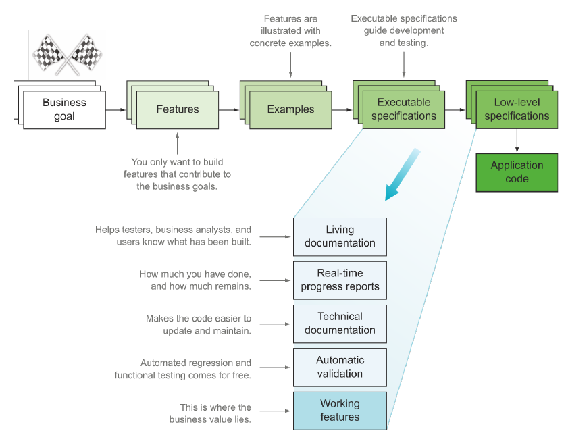
Figure 1.6 The principal activities and outcomes of BDD. Note that these activities occur repeatedly and continuously throughout the process; this isn’t a single linear Waterfall-style process, but a sequence of activities that you practice for each feature you implement.
You can add as much detail as you need to the example cards, but it is generally better to keep them light-weight and succinct. For example, if the outcome isn’t obvious, you can note it down on the card using an arrow (you can see an example of this notation in the third example shown above). You can also use bullet points to indicate examples where several inputs or steps are involved.