concept project in category BDD

This is an excerpt from Manning's book BDD in Action Second Edition.
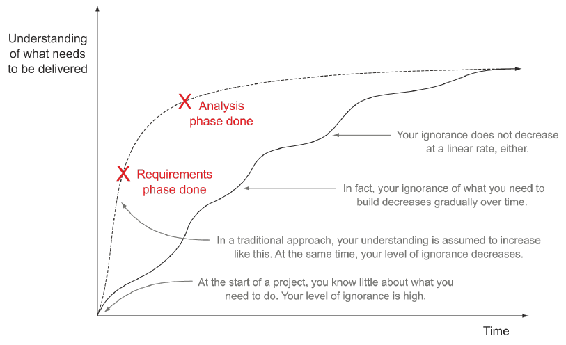
Figure 1.4 At the start of a project, there are many unknowns. You reduce these unknowns as the project progresses, but not in a linear or very predictable way.
The benefits of living documentation and executable specifications don’t stop at the end of the project. A project developed using these practices is also significantly easier and less expensive to maintain.
In this chapter, we’ll look at a concrete example of how BDD might work on a real-world project. As you saw in the previous chapter, BDD involves the development team engaging in conversations with the customer throughout the project, using examples to build up a more concrete and less ambiguous understanding of what the business really needs. You write specifications in an executable form that you can use to define software requirements, drive their implementation, and verify the product you deliver. You can also apply these techniques during more high-level requirements analysis, helping you focus on the capabilities and features of the application that will genuinely add value to the business.
This command lists the available matching archetypes, and prompts them to chose the archetype the want to use. There is only one, so they enter “1”. Next, they enter a Maven group id (“manning.bddinaction”) an artefact id (“train-timetables”), and an initial version (they leave this as the default of “1.0-SNAPSHOT”). Maven also prompts for the root package of the project (which they leave as the default value, which is the same as the group id). The whole process looks something like this:
[INFO] Generating project in Interactive mode
[WARNING] No archetype found in remote catalog. Defaulting to internal catalog
[INFO] No archetype defined. Using maven-archetype-quickstart (org.apache.maven.archetypes:maven-archetype-quickstart:1.0)
Choose archetype:
1: local -> net.serenity-bdd:serenity-cucumber4-archetype (Serenity automated acceptance testing project using Selenium 2, JUnit and Cucumber-JVM)
Choose a number or apply filter (format: [groupId:]artifactId, case sensitive contains): : 1
Define value for property 'groupId': manning.bddinaction
Define value for property 'artifactId': train-timetables
Define value for property 'version' 1.0-SNAPSHOT: :
Define value for property 'package' manning.bddinaction: :
Confirm properties configuration:
groupId: manning.bddinaction
artifactId: train-timetables
version: 1.0-SNAPSHOT
package: manning.bddinaction
Y: : Y
[INFO] ---------------------------------------------------------------------
[INFO] Using following parameters for creating project from Archetype: serenity-cucumber4-archetype:2.0.72
[INFO] ---------------------------------------------------------------------
-
[INFO] BUILD SUCCESS
[INFO] ---------------------------------------------------------------------
[INFO] Total time: 30.818 s
[INFO] Finished at: 2019-09-22T17:14:18-04:00
[INFO] ---------------------------------------------------------------------

This is an excerpt from Manning's book BDD in Action: Behavior-Driven Development for the whole software lifecycle.
One fact of life in software development is that there will be things you don’t know. Changing requirements are a normal part of every software project. Knowledge and understanding about the problem at hand and about how best to solve it increases progressively throughout the project.
In software development, each project is different. There are always new business requirements to cater to, new technological problems to solve, and new opportunities to seize. As a project progresses, market conditions, business strategies, technological constraints, or simply your understanding of the requirements will evolve, and you’ll need to change your tack and adjust your course. Each project is a journey of discovery where the real constraint isn’t time, the budget, or even programmer hours, but your lack of knowledge about what you need to build and how you should build it. When reality doesn’t go according to plan, you need to adapt to reality, rather than trying to force reality to fit into your plan. “When the terrain disagrees with the map, trust the terrain” (Swiss Army proverb).
Users and stakeholders will usually know what high-level goals they want to achieve and can be coaxed into revealing these goals if you take the time to ask. They’ll be able to tell you that they need an online ticketing system or a payroll solution that caters to 85,000 different employees. And you can get a feel for the scope of the application you might need to build early on in the project.
But the details are another matter entirely. Although users are quick to ask for specific technical solutions to their problems, they’re not usually the best-placed to know what solution would serve them best, or even, for that matter, what solutions exist. Your team’s collective understanding of the best way to deliver these capabilities, as well as the optimal feature set for achieving the underlying business goals, will grow as the project progresses.
As illustrated in figure 1.4, the more prescriptive, plan-based requirements-analysis techniques suppose that you can learn almost all there is to know about a project’s requirements, as well as the optimal solution design, very quickly in the early phases of the project. By the end of the analysis phase, the specifications are signed-off on and locked down, and all that remains to do is code.
Figure 1.4. At the start of a project, there are many unknowns. You reduce these unknowns as the project progresses, but not in a linear or very predictable way.
![]()
Of course, reality doesn’t always work this way. At the start of the project, a development team will often have only a superficial understanding of the business domain and the goals the users need to achieve. In fact, the job of a software engineering team isn’t to know how to build a solution; it’s to know how to discover the best way to build the solution.
The team’s collective understanding will naturally increase over the duration of the project. You become less ignorant over time. Toward the end of the project, a good team will have built up a deep, intimate knowledge of the user’s needs and will be able to proactively propose features and implementations that will be better suited to the particular user base. But this learning path is neither linear nor predictable. It’s hard to know what you don’t know, so it’s hard to predict what you’ll learn as the project progresses.
For the majority of modern software development projects, the main challenge in managing scope isn’t to eliminate uncertainty by defining and locking down requirements as early as possible. The main challenge is to manage this uncertainty in a way that will help you progressively discover and deliver an effective solution that matches up with the underlying business goals behind a project. As you’ll see, one important benefit of BDD is that it provides techniques that can help you manage this uncertainty and reduce the risk that comes with it.
1. Why is the software being built (what is the project’s vision statement)?
2. How will the project deliver value to the organization (what are the project’s business goals)?
3. What stakeholders are involved in the project, and how will the project affect them?