concept requirement in category BDD

This is an excerpt from Manning's book BDD in Action Second Edition.
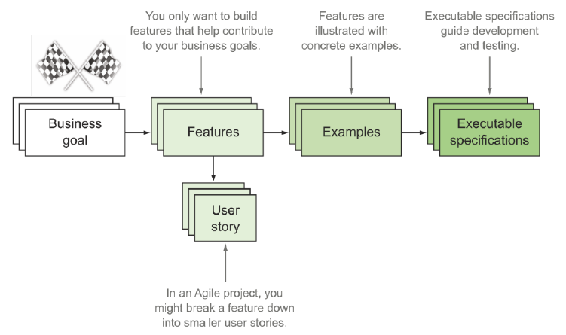
BDD practitioners use conversations around concrete examples of system behavior to help understand how features will provide value to the business. BDD encourages business analysts, software developers, and testers to collaborate more closely by enabling them to express requirements in a more testable way, in a form that both the development team and business stakeholders can easily understand. BDD tools can help turn these requirements into automated tests that help guide the developer, verify the feature, and document what the application does.
Figure 1.7 Examples play a primary role in BDD, helping everyone understand the requirements more clearly.

This is an excerpt from Manning's book BDD in Action: Behavior-Driven Development for the whole software lifecycle.
As you’ve seen, uncertainty about requirements is a major challenge in many software projects, and heavy upfront specifications don’t work particularly well when confronted with a shifting understanding of what features need to be delivered.
In this chapter, we’ll focus on an important part of BDD that you need to understand if you’re to get the most out of whatever BDD strategy you adopt. You’ve seen how BDD encourages teams to express requirements in terms of executable specifications that can be run in the form of automated tests. These executable specifications become the definitive reference (often referred to as the “source of truth”) for the current set of application requirements. The definitive form of these executable specifications is generally source code, so they fit neatly into the overall development process and drive the automated tests. The reports generated by the automated tests refer back to the original executable specifications. These reports, which combine the original specifications, acceptance criteria, and test results, are what we call living documentation.
Feature coverage tells you how many acceptance criteria have been defined and automated for each requirement. It also tells you what requirements have no automated acceptance criteria. Figure 11.5 illustrates this idea. It shows reports from a Thucydides project configured to organize requirements in terms of epics and stories. The Spending Points epic hasn’t been started yet, so it has no automated scenarios and no test results. The Authentication epic has one implemented story, but two others exist only in the backlog. All of these still need to appear in the report so that the team can get a clearer overall view of the project status.