concept chain in category blockchain

This is an excerpt from Manning's book Blockchain in Action.
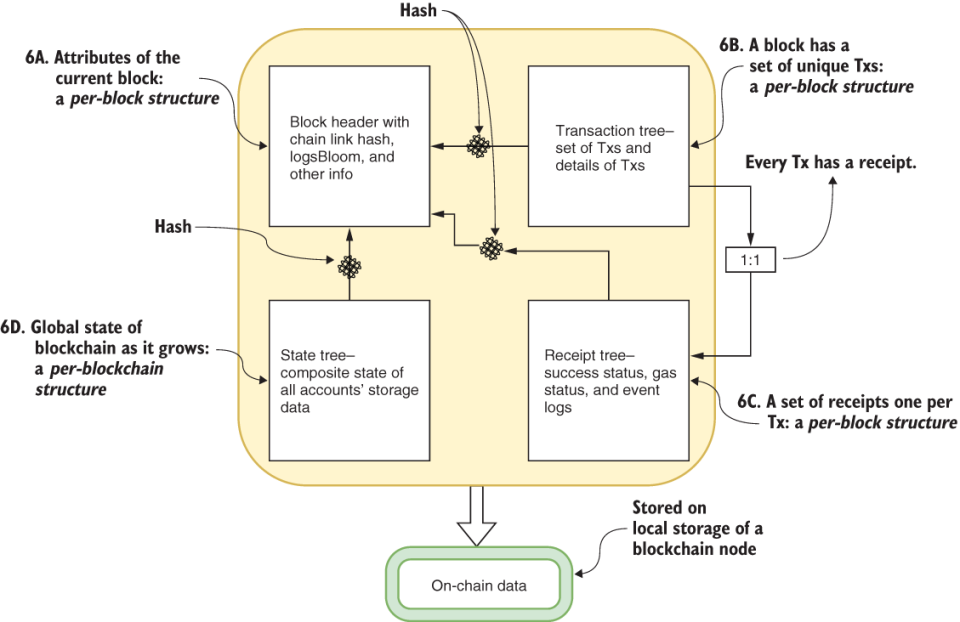
In addition to these items, observe the hash symbols in this figure, indicating that item 6A--the block header--contains (stores) the hashes of items 6B, 6C, and 6D. The hash of these items is the hash of the current block. The hash of the current block is stored in the next block added to the chain. Thus, the hash of a block stored as part of the following (newly added) block forms the chain link of the blockchain.
As shown in figure 6.2, the block header, Tx tree, and receipt tree are per-block data structures. That characterization means that for every new block added to the chain, there is a new instance of the block header, a new Tx tree, and a new set of receipts.
On the other hand, the state tree is a per-blockchain data structure: it stores the current state of all the accounts on the blockchain, starting from the genesis block. The state tree records the history of what happened on the blockchain as a whole and how it happened. Its state keeps changing as affected by the Txs executed. The state information is valuable information for verifying that certain Txs took place and for mining (or searching) for particular actions, changes, and events. You can analyze the on-chain data stored over a range of blocks to identify a pattern in transactions issued for a specific smart contract, for example.
emit BiddingStarted();
emit RevealStarted();
All these examples look simple enough: define an event and then call (emit or trigger) it. Now let’s see how you use these concepts and access a triggered event to notify users of what’s happening in your application. We’ll reuse the blind auction use case from chapter 5, but with the significant addition of events and related modifications to the code.

This is an excerpt from Manning's book Permissioned Blockchains in Action.
Trying to analyze and filter raw data on-chain is generally infeasible - every operation is replicated across all nodes so doing heavy computation on chain is expensive. So oracle services serve as an off-chain support to the chain. In the case of Joe and the insurance company, an oracle would provide the input on weather. In case of the new app, Sue will need oracles to collect all sorts of information throughout the process of wine production. There are a few ways Sue could implement the oracles she needs.
While there is always some tension between maximizing privacy and maximizing transparency, the properties of blockchains further compound this tension. For one, unlike traditional databases, there is no possibility of deleting sensitive information after it has been committed to the chain. Second, because of the distributed nature of blockchains, the sensitive data is shared among all the stakeholders by default. This is in opposition to traditional databases where data needs to be explicitly requested to transfer from one organization to another.