concept network in category blockchain

This is an excerpt from Manning's book Blockchain in Action.
A smart contract is an immutable executable code representing the logic of a Dapp. The data variables and functions defined in a smart contract collectively represent the state and operations for enforcing an application’s (Dapp’s) rules for verification, validation, and recording on the blockchain.

This is an excerpt from Manning's book Permissioned Blockchains in Action.
The Internet is full of blog posts that can lead you to a conclusion that there are three stages of building a network: you start with a centralized system (which is “bad”), then you introduce multiple actors and “decentralize” it, and then make those nodes “equal” to create a distributed system (which is “good”). If you’re anything like us, you would have found those blog posts unconvincing. Aside from the lack of nuance around good vs bad, the thing that is frustrating about such posts is the lack of clarity around what is meant by centralization. Let us not make the same mistakes here and disambiguate those words. To help us with that task, we will use the simplified version of legal decision making presented in figure 1.1 for discussion.
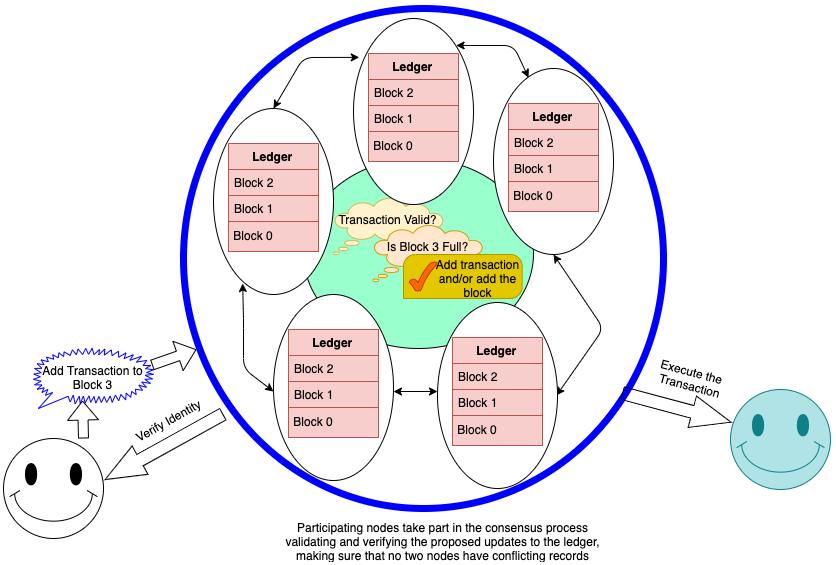
First, Alice generates an account. This account, which is effectively a public key pair, is used as her virtual identity. It is used for signing every transaction, so that the network knows it is Alice who is submitting it. The wallet in this figure is simply a piece of software that stores all of Alice’s account keys.