concept peer in category blockchain

This is an excerpt from Manning's book Blockchain in Action.
Even though Bitcoin appeared to have launched suddenly in 2009, the idea of a working digital currency has been a quest since the dawn of computing. Bitcoin’s blockchain technology stands on a strong foundation of more than 40 years of scientific research in cryptography, hashing, peer-to-peer networks, and consensus protocols. Figure 1.1 provides a brief history of blockchain, its innovation and robust scientific foundation, and its transformative effect on modern networked systems.
On completion of this chapter, you’ll know the fundamental concepts of blockchain and decentralized applications, such as transactions, blocks, a chain of blocks, nodes, networks of nodes, and the protocol that ties all these elements together. With these many components, blockchain is indeed a complex system. An understanding of these foundational concepts is, therefore, imperative for the blockchain application design and development that you’ll embark on in chapters 2-11.

In a traditional computing system, a participant is identified by a username and an associated password. These elements are used for authentication. This <username, password> combination will not work in a decentralized system, because peers are beyond the usual boundaries of trust (as in the relationships university-student or country-citizen). The solution is to provide a unique identifier for each participant based on cryptographic algorithms. (You’ll learn more about this topic in chapter 5.) All the participants interacting with the blockchain, including a smart contract, have an account number or address that uniquely identifies them:

This is an excerpt from Manning's book Permissioned Blockchains in Action.
The Rise of Peer-to-Peer Networking
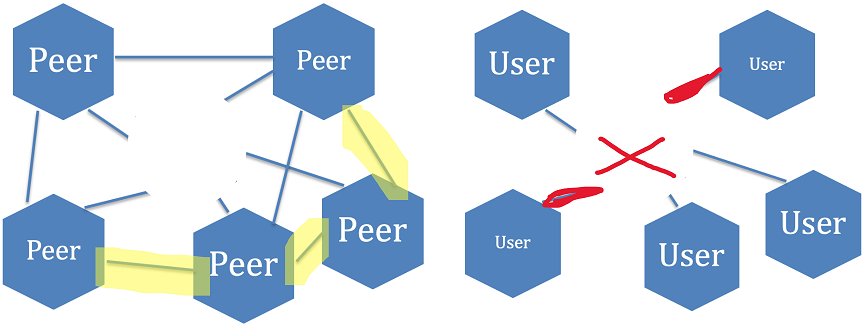
Digital sharing, as opposed to downloading files from servers, was enabled by the creation of peer-to-peer (P2P) networking. On a P2P system, the workload is balanced between participants who have equal rights. The participants in a P2P network are called “nodes”; remember that word, you’ll see it a lot. The architecture of P2P systems turned around our thinking about data and resource ownership. In server-client settings, the clients’ consume resources supplied by the servers. In P2P nodes are both suppliers and consumers. This meant creating a digital community and allowing it to collaborate, leveraging the power of collaboration. Peer to peer was not some grand invention - distributed computing was known for a while. It was the development of use-cases that helped benefit the community that popularized it.
Figure 2.8. Removing a peer from the P2P network doesn’t stop the communication between the remaining peers. In a centralized one it does.